

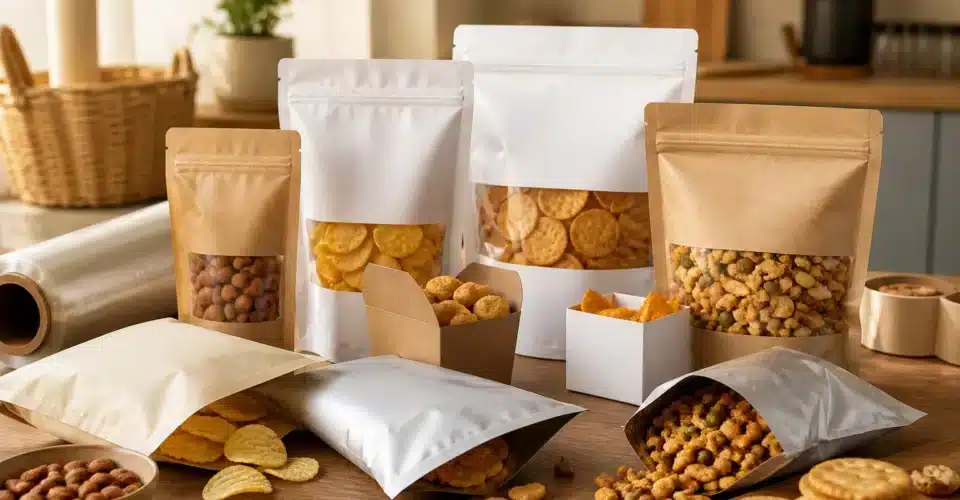
In the snack food category, the packaging is not just a container — it is the product’s first salesperson, its freshness guarantor, and often the deciding factor between a repeat purchase and a brand switch. Snack consumers are among the most demanding in grocery retail: they expect products to be crunchy on day one and still crunchy on day sixty, to look visually appealing in a crowded shelf environment, and to open, reseal, and dispense in a way that fits their on-the-go lifestyle.
Meeting those expectations consistently is a packaging engineering challenge. Moisture is the enemy of crunch. Oxygen is the enemy of flavour. And poor shelf appeal is the enemy of the sale before the consumer ever gets to taste the product.
At Vista Packaging, we work with snack food producers across chips, nuts, crackers, pretzels, cookies, and emerging healthy snack categories to design and supply snack packaging that delivers on crunch retention, flavour preservation, and shelf presence — from single-serve impulse packs to club-store multipacks and e-commerce formats.
This guide covers the science of snack packaging, the film and format options available to snack producers, and the practical decisions that determine whether your packaging is a brand asset or a liability.
Why Does Snack Packaging Fail? The Science of Staleness and Loss of Crunch
Understanding why snack packaging fails is the foundation of specifying it correctly. Two primary mechanisms drive quality loss in packaged snacks: moisture absorption and oxidation.
Moisture Absorption and Loss of Crunch
Crunchy snacks — chips, crackers, pretzels, popcorn, extruded corn snacks — achieve their texture through a precise moisture content achieved during manufacture. For most crunchy snacks, this is below 3% moisture by weight. When the product is exposed to ambient humidity inside its packaging, moisture is absorbed, disrupting the crisp cellular structure that creates the crunch sensation, and producing the soft, stale texture that drives consumer dissatisfaction and negative reviews.
The rate of moisture absorption depends entirely on the packaging film’s Moisture Vapour Transmission Rate (MVTR). A film with a high MVTR will allow ambient humidity to migrate into the pack steadily over its shelf life — producing a product that meets crunch expectations on day one but fails by week three.
For snack packaging, specifying the correct MVTR for your product’s target shelf life, distribution environment, and moisture content at packing is not optional — it is the most fundamental technical decision in the packaging specification.
Oxidation and Flavour Degradation
The second major mechanism of snack quality loss is oxidation — the reaction between oxygen inside the pack and the fats present in the snack product. High-fat snacks (chips, nuts, cheese-flavoured crackers) are most susceptible, but even relatively low-fat products experience flavour deterioration from oxygen exposure over time.
Oxidative rancidity produces the characteristic stale, cardboard-like, or soapy off-flavours that consumers describe when snacks are “past their best.” The rate of oxidation is directly controlled by the Oxygen Transmission Rate (OTR) of the packaging film. Lower OTR means less oxygen migration into the pack, slower oxidative reactions, and longer flavour shelf life.
For the most oxygen-sensitive snack products, nitrogen flushing — replacing the oxygen-rich air inside the pack with inert nitrogen gas before sealing — is used in conjunction with low-OTR film to essentially eliminate oxidation as a shelf life limiting factor.
What Are the Key Film Properties for Effective Snack Packaging?
Specifying snack packaging film correctly requires understanding and balancing these technical parameters:
Moisture Vapour Transmission Rate (MVTR): The lower the MVTR, the better the crunch retention. Most high-performance snack films target MVTR values of 1–5 g/m²/day or below. Standard commodity films with MVTR values of 10–20 g/m²/day will produce noticeable texture degradation in moisture-sensitive products within 4–8 weeks.
Oxygen Transmission Rate (OTR): Critical for flavour-sensitive and high-fat snack products. Premium snack packaging typically targets OTR below 10–30 cc/m²/day. Products going into nitrogen-flushed MAP packs require OTR values in the 1–5 cc/m²/day range or below to maintain the low-oxygen atmosphere through shelf life.
Seal integrity: The best barrier film in the world is worthless if the pack seals are inconsistent. Seal strength, seal width, and seal temperature range are all critical film parameters for snack packaging — particularly on high-speed vertical form-fill-seal (VFFS) lines where sealing conditions vary with line speed and ambient temperature.
Machinability: Snack lines run fast — typically 60 to 120+ packs per minute on industrial VFFS equipment. Packaging film must run reliably on the machine with consistent tension, no tearing, accurate registration of print marks, and stable sealing performance at high speeds. Film that performs in laboratory conditions but runs inconsistently on the production line costs money in downtime, waste, and rejects.
Print quality and shelf presence: Snack packaging is a high-competition retail environment. Film surface energy must support high-quality flexographic or gravure print that reproduces brand colours accurately and consistently. Matte, metallic, and tactile finishes all have applications in premium snack positioning.
What Are the Main Snack Packaging Formats — and Which Is Right for Your Product?
Pillow Pouch (Vertical Form-Fill-Seal / VFFS)
The pillow pouch is the dominant format in global snack packaging — the familiar fin-seal bag that holds everything from potato chips to rice crackers. Formed on VFFS machines from rollstock film, pillow pouches are high-speed, highly cost-efficient, and available in an enormous range of sizes from single-serve (25–30g) to large sharing formats (500g+).
Best for: Chips, extruded snacks, popcorn, crackers, pretzels, any high-volume ambient snack. The nitrogen-flushed pillow pouch remains the industry standard for crunchy snack preservation.
Key considerations: Pillow pouches provide excellent barrier performance and nitrogen-flush compatibility, but limited shelf presence compared to stand-up formats. Pack design must work hard on the front panel to communicate brand identity in the confined space of a hanging peg display or shelf bay.
Stand-Up Pouch (SUP)
Stand-up pouches have grown rapidly in premium and natural snack segments — trail mixes, gourmet nuts, healthy chips, protein snacks, and premium popcorn. The gusseted base allows the pack to stand upright on shelf, creating 40–60% more visible brand surface area than an equivalent pillow pouch. Resealable zipper options address the practical need for portion control and in-home freshness maintenance.
Best for: Nuts, trail mixes, premium chips and crisps, healthy snacks, granola, protein bars in bulk, and any snack positioned in the premium or natural segment.
Key advantages over pillow pouch:
- Superior shelf presence and brand communication
- Resealable zipper options extend in-home product freshness
- Stronger brand equity signals through premium format associations
- Compatible with nitrogen flush MAP for equivalent crunch protection
Vista Packaging supplies stand-up pouches for snack producers in both rollstock (for form on filling line) and preformed (pre-made, supplied flat for filling) configurations.
Flat Bottom Pouch (Block Bottom)
Flat bottom pouches — also called block bottom or K-seal pouches — offer maximum stability and a 360-degree brand panel. When filled, they stand upright with four flat side panels, a flat base, and maximum retail presence. This format is increasingly used in premium snack retail, particularly in independent specialist retail and premium supermarket channels.
Best for: Premium positioning in gourmet snacks, specialty nuts, artisan crackers, and any snack product targeting a shelf-impact differentiation strategy.
Rollstock Film for FFS Lines
For producers operating horizontal or vertical form-fill-seal lines, rollstock film is the standard supply format. Vista Packaging supplies custom-printed rollstock for snack VFFS and HFFS applications, engineered for consistent machinability, register accuracy, and barrier performance at production line speeds.
How Does Nitrogen Flushing Work in Snack Packaging — and Is It Worth It?
Nitrogen flushing is the process of evacuating the oxygen-containing air from a snack pack and replacing it with inert nitrogen gas (N₂) before final sealing. The result is a pack where the internal atmosphere contains less than 2–3% residual oxygen — compared to 21% in normal air — dramatically slowing the oxidative reactions that cause rancidity and flavour loss.
Beyond flavour protection, nitrogen also provides the “pillow” effect — the characteristic slightly inflated appearance of chip packs — which provides physical cushioning that protects fragile snack products from breakage during transport and handling.
Is nitrogen flushing worth the investment?
For any snack product with:
- A fat content above 15%
- A target shelf life of 8 weeks or more
- A distribution chain involving temperature variation or long transit
- Premium positioning where consumer quality expectation is high
…nitrogen flushing is not optional — it is essential. The incremental cost of nitrogen at modern filling line speeds is minimal relative to the shelf life, quality, and brand reputation value it delivers.
The prerequisite for nitrogen flushing to be effective is low-OTR film. Flushing nitrogen into a pack made from high-OTR commodity film simply delays the inevitable — oxygen re-enters through the film before the pack reaches the consumer. Vista Packaging’s snack films are specified with OTR values appropriate for the target shelf life and nitrogen-flush conditions of each application.
How to Choose the Right Snack Packaging for Your Product
Use this decision framework to narrow your format and film specification choices:
Step 1: Define your product characteristics. What is the moisture content at packing? What is the fat content? Is the snack crunchy (requiring moisture barrier) or soft (requiring moisture retention)? What is the target shelf life?
Step 2: Define your production environment. What filling equipment do you operate — VFFS, HFFS, or manual/semi-automatic filling for preformed pouches? What is your target line speed? What are your sealing conditions?
Step 3: Define your retail environment. Is the product sold ambient or chilled? Is it peg-hung or shelf-standing? Is it sold in mainstream supermarkets, independent trade, or e-commerce? Each environment has different requirements for pack format, graphics, and structural performance.
Step 4: Define your brand positioning. Is this a mainstream value brand, a premium brand, or a natural/healthy brand? The packaging format and print specification must align with the price point and consumer expectations of your positioning.
Step 5: Engage your packaging supplier early. The best snack packaging outcomes come from involving a technically capable packaging partner at the product development stage — not after launch when problems become expensive. Vista Packaging works with snack producers from initial concept through to production line validation.
How Vista Packaging Delivers for Snack Producers
Vista Packaging’s snack packaging solutions are developed and manufactured at our facility in Vasai East, India, with supply to snack producers across domestic and international markets. Our snack film and pouch range includes:
- Custom-printed VFFS rollstock for high-speed snack lines in mono and multi-layer barrier structures
- Preformed stand-up pouches with or without zipper, in a range of sizes and barrier specifications
- Flat bottom pouches for premium snack retail positioning
- Nitrogen-flush-compatible barrier films for extended shelf life and crunch retention
- Sustainable snack packaging including mono-material recyclable structures and reduced-material-weight downgauged films
Every snack packaging project at Vista Packaging begins with a technical consultation — we understand your product, your line, your retail environment, and your shelf life targets before we recommend a specification. This ensures you get packaging that performs from day one on the production line to the moment the consumer opens the pack.
People Also Ask: Snack Packaging
What packaging is best for keeping chips crunchy?
Low MVTR (moisture vapour transmission rate) film with nitrogen flushing provides the best crunch retention for chips and similar crunchy snacks. The nitrogen replaces oxygen in the pack (preventing rancidity) and provides physical cushioning, while the low MVTR film prevents ambient moisture from softening the snack over its shelf life.
How does nitrogen flushing extend snack shelf life?
Nitrogen flushing replaces the oxygen inside a snack pack with inert nitrogen gas before sealing, reducing residual oxygen levels to 2–3% compared to 21% in normal air. This dramatically slows oxidative rancidity (the primary cause of flavour degradation in fatty snacks) and can extend shelf life by 50–200% depending on the product.
What is the difference between pillow pouches and stand-up pouches for snacks?
Pillow pouches (formed on VFFS machines from rollstock) are more cost-efficient and standard for high-volume snack production. Stand-up pouches offer superior retail shelf presence, resealable options, and stronger brand premium signals. The choice depends on production format, retail channel, and brand positioning.
What film properties are most important for snack packaging?
MVTR (for crunch retention), OTR (for flavour preservation), seal integrity, and machinability on production line equipment are the four most critical film properties for snack packaging performance.
Conclusion: Your Snack Packaging is Your Brand’s First Impression
The consumer’s decision to pick up your snack product happens in seconds at the shelf — and their decision to buy it again is determined the moment they open the pack and take the first bite. Packaging that delivers visual impact at the shelf and genuine freshness at the moment of consumption is the foundation of snack brand loyalty.
Every element of that experience — the crunch on opening, the fresh aroma, the intact appearance of individual pieces, the satisfying reseal — is determined by packaging specification decisions made before the product ever reaches retail. Getting those decisions right requires genuine technical depth and a packaging partner who understands both the science of snack preservation and the commercial realities of snack retail.
Contact Vista Packaging to discuss your snack packaging requirements — from initial specification through to production line support.