

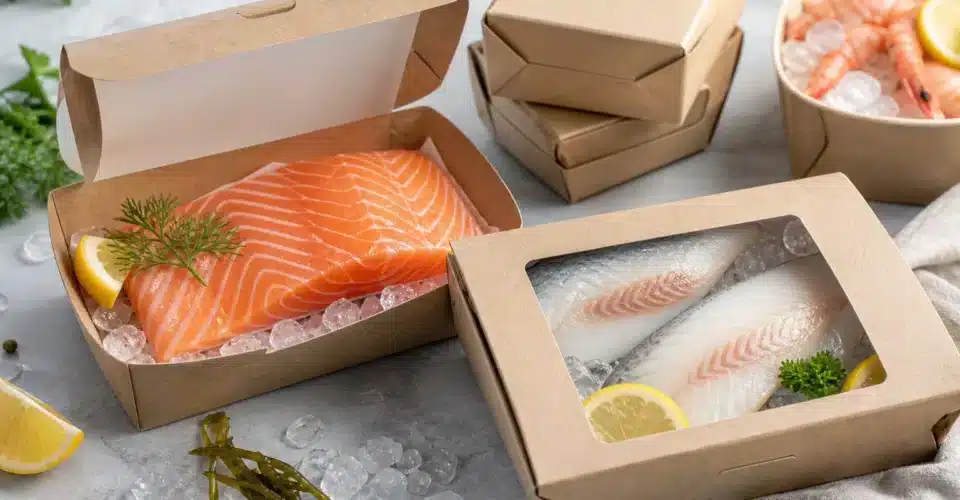
The seafood packaging category is undergoing one of the most significant material transitions in its history. Driven by retailer sustainability commitments, extended producer responsibility (EPR) legislation, and rapidly shifting consumer expectations around plastic use, the industry is moving away from conventional plastic trays and multi-layer laminate films toward paper-based and paperboard alternatives – particularly for premium products like fresh salmon, trout, sea bass, and value-added fish portions.
This shift is not merely cosmetic. Paper board packaging for seafood represents a genuine engineering advance that addresses both the environmental concerns of plastic packaging and the functional requirements of a product category that is among the most demanding in the entire food industry. Fresh fish is highly perishable, moisture-intensive, odour-sensitive, and requires physical protection that prevents damage to delicate flesh during the distribution journey from processing plant to retail display.
At Vista Packaging, we develop and supply paper board packaging solutions for seafood producers and retailers who are committed to both environmental responsibility and uncompromising product quality. This guide explains why paper board is the right choice for salmon and fish packaging in 2026 – technically, commercially, and sustainably.
Why Is Seafood Such a Demanding Packaging Application?
To understand why paper board represents a meaningful advance in seafood packaging, it is necessary first to understand what the packaging must achieve. Fresh fish and salmon present a combination of challenges that few other food categories match:
High moisture content and exudate. Fresh fish releases liquid exudate – a mixture of water, blood, and soluble proteins – from the cut surface throughout its refrigerated shelf life. Packaging must either absorb this exudate (preventing it from pooling around the product and accelerating spoilage) or manage it in a controlled way that does not compromise product appearance. A puddle of liquid around a fresh salmon fillet at the retail display is a critical quality failure.
Delicate texture and physical fragility. Fish flesh – particularly premium species like Atlantic salmon, sea bass, and hake – is soft and easily damaged by pressure or abrasion. Packaging must provide structural support and physical protection without creating pressure points that bruise or indent the product.
Short shelf life window. Fresh fish operates in one of the shortest shelf life windows in the entire grocery category – typically 5–10 days from catch to consumer for premium fresh product. Every hour of the distribution journey matters, and packaging that compromises the cold chain, accelerates microbial growth, or allows exudate pooling directly shortens the commercially available shelf life.
Strong consumer quality signals. Seafood consumers make purchase decisions based on the appearance of the product – its colour, texture, and the visual cleanliness of the packaging environment. A premium salmon fillet presented in professional, clean packaging with good colour visibility generates significantly higher purchase rates and perceived quality scores than the same product in tired or cluttered packaging.
Sustainability expectations. Salmon and premium seafood consumers are among the most environmentally conscious in the grocery category. Brands that use sustainable, visually transparent packaging signal alignment with these values – and brands that persist with conventional plastic packaging face growing consumer and retailer pressure.
What Is Paper Board Packaging for Seafood – and How Does It Work?
Paper board packaging for fresh fish and salmon takes several structural forms, but the core technology in all of them is a paper or paperboard substrate with functional coatings or liners that provide the moisture resistance, barrier properties, and structural performance that a fresh seafood product requires.
Coated paperboard trays are the primary format for fresh fish retail at supermarket level. A paperboard blank is formed into a tray shape – typically by die-cutting and folding or by thermoforming – and coated with a functional barrier layer that prevents moisture from degrading the structural integrity of the paperboard base. An absorbent pad inside the tray manages exudate from the fish product. A lidding film – typically a clear or printed film with appropriate oxygen and moisture barrier properties – is heat-sealed across the top.
Paper board with MAP (Modified Atmosphere Packaging). For extended shelf life fresh fish – particularly salmon and trout fillets in supermarket retail – paper board trays are increasingly used as the base component in MAP systems where the internal atmosphere is adjusted to CO₂-rich conditions that inhibit bacterial growth. This combination extends fresh salmon shelf life from a typical 6–8 days to 12–18 days, with paper board providing the sustainable outer structure and a thin functional inner liner providing the gas barrier.
Board-based skin packs. In skin packaging, a thin film is vacuum-formed directly over the product surface, creating a tight, transparent “second skin” that adheres closely to the salmon fillet and eliminates the headspace where spoilage gases accumulate. When the skin film is supported by a paper board backing card instead of a conventional plastic tray, the result is a packaging format with significantly lower plastic content – in some formats, over 80% of the pack weight is recyclable paper board.
Why Is Paper Board the Eco-Friendly Choice for Salmon and Fish Packaging?
The environmental case for paper board in seafood packaging is built on four distinct advantages:
1. Recyclability and Waste Stream Clarity
Conventional plastic trays used in seafood packaging – typically PET or PP thermoformed formats – are technically recyclable but practically challenging to recycle in most municipal waste streams. Food contamination from fish residues, the presence of absorbent pads, and the multilayer film laminated to the tray all create sorting and cleaning challenges that result in a significant proportion of seafood plastic trays ending up in landfill or incineration rather than recycled material streams.
Paper board packaging for fish, when designed with recyclability in mind, enters the paper waste stream – one of the most efficient and widely available recycling infrastructure categories globally. When the paper board component is designed to be separable from any thin plastic liner or lidding film, consumers can recycle the board and dispose of the minimal film component separately.
2. Lower Carbon Footprint vs. Plastic Alternatives
Life cycle analysis (LCA) studies consistently show that paper-based packaging has a lower greenhouse gas emission profile than equivalent plastic-based packaging over its full life cycle, particularly when the fibre is sourced from sustainably managed forests with Forest Stewardship Council (FSC) certification. For premium seafood brands with published sustainability commitments, the ability to report reduced packaging carbon footprint is a commercially valuable metric.
3. Renewable Raw Material Origin
Paper board is derived from wood fibre – a renewable biological resource when sourced from responsibly managed forests. Plastic packaging trays are derived from fossil-fuel-based petrochemical feedstocks. As plastic packaging becomes increasingly subject to regulatory and extended producer responsibility (EPR) levy schemes globally, the raw material origin of packaging represents a growing commercial and compliance cost differential.
4. Consumer Perception and Brand Premium Signal
Consumer research consistently identifies paper-based packaging with premium quality, environmental responsibility, and brand authenticity signals. For fresh salmon – a product positioned at the premium end of the protein category in most markets – packaging that communicates sustainability reinforces the product’s broader quality story. Retailers including major UK supermarkets and European grocery chains have publicly committed to transitioning fresh fish ranges to paper-based formats, making this not merely a brand preference but an increasingly mandatory requirement for retail listing.
Does Paper Board Packaging Maintain Freshness as Well as Plastic?
This is the most important practical question for seafood producers considering a transition to paper board packaging – and the honest answer requires nuance.
Conventional paper board without functional coatings or barriers is not suitable for fresh fish packaging. The moisture from fish exudate would rapidly compromise structural integrity, the board would soften and deform, and the absence of gas barrier properties would eliminate any possibility of extended shelf life under MAP conditions.
However, modern paper board packaging for seafood is not conventional paper board – it is an engineered, functionally coated material system designed specifically for the demands of fresh protein applications.
Moisture resistance coatings applied to the inner surface of the paper board tray prevent exudate from penetrating and degrading the board structure. These coatings are available in both conventional (polyethylene laminate) and water-based dispersion formats – the latter being compatible with recycling streams.
Absorbent pad integration within coated paper board trays manages exudate actively, drawing liquid away from the product surface to maintain the clean, dry appearance that retail quality standards require.
Thin functional film inners provide gas barrier and MAP compatibility within a primarily paper board structure. When the inner film is sufficiently thin (typically below 50 microns), the overall pack contains significantly less plastic than a conventional tray-and-lid combination while maintaining equivalent gas barrier performance.
Comparative shelf life performance: In trials conducted across multiple salmon and fresh fish producers adopting paper board MAP formats, product shelf life has been maintained at equivalent or superior levels to conventional PET tray MAP packs – provided the paper board specification, functional coating, and MAP conditions are correctly aligned.
Vista Packaging works with seafood producers to specify paper board packaging that does not ask them to compromise on freshness, shelf life, or product presentation. The functional performance that your product requires and the environmental goals your brand has committed to are not in conflict – they require only the right material engineering.
What Are the Structural Formats Available in Paper Board Seafood Packaging?
Coated Board Tray with Lidding Film
The most widely adopted format in retail supermarket fresh fish. A formed paperboard tray, coated for moisture resistance, holds the fish product on an absorbent pad. A lidding film – clear for product visibility or printed for branding – is heat-sealed across the top. Available in ambient (short shelf life) and MAP (extended shelf life) configurations.
Best for: Fresh salmon fillets, sea bass, trout, cod, hake, white fish portions, value-added fish products.
Board-Backed Skin Pack
A paperboard backing card (printed or plain) forms the base of the pack. A skin film is vacuum-formed directly over the fish product and welded to the card surface, creating a taut, clear “second skin” that showcases product colour and texture while eliminating the headspace that conventional film packs contain. Provides the most visually premium presentation of any fresh fish format.
Best for: Premium fresh salmon portions, whole gutted fish, fresh tuna steaks, and any product where maximum product visibility and premium positioning are the primary retail objectives.
Folded Board Carrier with Tray Insert
A hybrid format where a structural outer board carrier – providing branding surface and structural protection – is combined with a functional inner tray (paper board or thin film) that directly contacts the product. This format is particularly used in premium and gifting seafood formats, where the outer carrier provides extensive branding space and a premium unboxing experience.
Best for: Premium gifting formats, restaurant-grade fish portions, subscription box distribution, and high-value seafood SKUs in independent specialist retail.
What Should Seafood Producers Look for When Specifying Paper Board Packaging?
These are the critical specification parameters for paper board seafood packaging:
Moisture resistance rating. The board’s Cobb value (water absorption test) determines whether it will maintain structural integrity in contact with fish exudate. Specify boards rated for the expected contact time and exudate volume of your product.
Barrier coating type and recyclability. If recyclability is a goal, specify water-based or dispersion barrier coatings that are compatible with paper recycling rather than conventional PE laminate coatings that contaminate paper recycling streams.
MAP compatibility. If extended shelf life through modified atmosphere is required, the functional inner layer must achieve the OTR specifications necessary to maintain your target gas atmosphere through the full shelf life period.
FSC certification. For producers and retailers with sustainable sourcing commitments, FSC-certified paper board provides auditable supply chain assurance of responsible forest management.
Print specification. Premium seafood brands require high-quality print on paper board surfaces – particularly outer carrier formats where branding and consumer communication are primary functions. Specify the number of print colours, varnish or laminate finish, and any special effects requirements at the outset.
How Vista Packaging Supports Seafood Producers with Paper Board Solutions
Vista Packaging’s paper board range for seafood applications is developed with full understanding of the technical requirements of fresh fish and salmon packaging – and the sustainability commitments that are increasingly shaping purchasing decisions in this category.
Our paper board seafood packaging capabilities include:
- Coated paper board trays with functional moisture resistance and MAP compatibility
- Board-backed skin pack systems for premium fresh fish presentation
- Custom-printed outer board carriers for gifting and premium seafood formats
- FSC-certified board sourcing for sustainability-committed producers and retailers
- Technical consultation on transitioning from conventional plastic tray formats to paper board equivalents without shelf life compromise
Every paper board seafood packaging project begins with a detailed technical assessment – understanding your product, your processing environment, your shelf life targets, your retail requirements, and your sustainability goals. The right paper board specification for salmon is different from the right specification for white fish; the requirements for a national supermarket listing are different from those for a premium independent fishmonger chain.
People Also Ask: Paper Board Seafood Packaging
Is paper board packaging suitable for fresh salmon?
Yes. Modern functional paper board packaging – with moisture resistance coatings, absorbent pad integration, and MAP-compatible barrier layers – provides equivalent freshness and shelf life performance to conventional plastic tray formats for fresh salmon, while offering significantly better environmental credentials and consumer sustainability perception.
Can paper board seafood packaging be recycled?
Paper board seafood packaging designed with recyclability in mind – using water-based barrier coatings and separable film components – enters the widely available paper recycling stream. Conventional PE-laminated board is less readily recyclable. Specify the coating type based on your target recyclability outcome.
How does paper board packaging compare to plastic for fish shelf life?
When correctly specified and used in MAP conditions, paper board seafood packaging maintains equivalent shelf life to plastic tray alternatives. Fresh salmon shelf life of 12–18 days is achievable in MAP paper board formats – equivalent to performance from PET plastic tray MAP packs.
Why are supermarkets switching to paper board packaging for fresh fish?
Major retailers globally have made public commitments to reduce plastic packaging across fresh protein categories. Paper board packaging for fresh fish delivers against these commitments while maintaining product quality, improving consumer sustainability perception, and meeting evolving EPR regulatory requirements in key markets including the UK and EU.
Conclusion: Paper Board Seafood Packaging Is Not a Compromise – It’s an Upgrade
The transition to paper board packaging in fresh seafood is not a sacrifice of product performance for environmental optics. When specified correctly and supported by the right functional engineering, paper board delivers equivalent freshness preservation, superior retail sustainability credentials, better consumer perception, and a more defensible position as EPR regulations tighten globally.
For salmon and fish producers planning range reviews, new product launches, or retailer tender submissions in 2026 and beyond, paper board packaging is not a “nice to have” – it is increasingly a commercial necessity that aligns with where the retail industry is heading.
Talk to Vista Packaging about transitioning your seafood range to paper board. We combine technical packaging expertise with genuine sustainability commitment to deliver solutions that work for your product, your production line, and your retailer.