

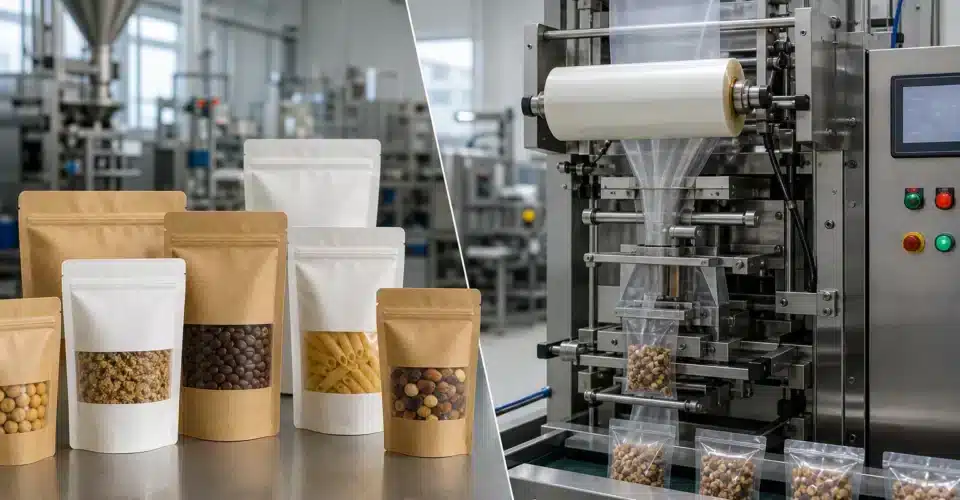
One of the most consequential decisions a food producer makes when setting up or scaling a packaging operation is choosing between preformed pouches and form-fill-seal (FFS) packaging — and it is a decision that is too often made on a single variable (usually upfront equipment cost) rather than a full total-cost-of-ownership analysis that accounts for film waste, line efficiency, format flexibility, labour requirements, and the cost of changeovers.
Both formats are capable of producing high-quality, well-sealed pouches for a wide range of food products. But they achieve that outcome through fundamentally different operational models, with different capital requirements, different ongoing cost structures, and different levels of flexibility and scalability.
At Vista Packaging, we supply both preformed pouches and rollstock film for form-fill-seal lines — which means we have no commercial incentive to push producers toward one format or the other. Our only interest is in helping you choose the right packaging format for your specific product, production volume, operational context, and commercial objectives. This guide gives you a complete, honest, technically grounded comparison.
What Is the Difference Between Preformed Pouches and Form-Fill-Seal?
Before comparing the two, it is worth being precise about what each format involves.
Preformed Pouches
A preformed pouch is a completed pouch — with all seals except the top fill opening — supplied by the packaging manufacturer. The producer receives flat, pre-made pouches (stand-up, flat, pillow, or other formats) and fills them on a separate filling machine. The fill opening is then sealed on the production line.
Preformed pouches are supplied by Vista Packaging in a range of formats:
- Stand-up pouches (SUP) — with a gusseted base that allows the filled pack to stand upright on shelf, available with or without zipper closures
- Flat pouches — for products where stand-up presentation is not required
- Spouted pouches — for liquid or semi-liquid products
- Speciality formats — including retort-compatible pouches for shelf-stable products
The filling machine used for preformed pouches is typically a simpler, lower-capital-cost system than an FFS machine. Some producers — particularly at small to medium scale — fill preformed pouches manually or semi-automatically, eliminating significant capital equipment costs.
Form-Fill-Seal (FFS) — Vertical and Horizontal
Form-fill-seal (FFS) systems create the pouch structure in line with the filling and sealing process, using a continuous roll of flat packaging film (rollstock). The film is formed into the pouch shape, sealed to create the side and bottom seams, filled with the product, and then top-sealed and cut into individual packs — all in a single continuous automated operation.
Vertical Form-Fill-Seal (VFFS) is the dominant FFS format in food packaging — the machine that produces the familiar pillow pouch used in snacks, coffee, frozen vegetables, and many other categories. Film is formed into a tube around a vertical forming tube, seams are sealed, the product drops in from above, and the top seal and cut are made.
Horizontal Form-Fill-Seal (HFFS) uses horizontally oriented forming, and is commonly used for products that cannot be dropped vertically (fragile items, liquids, irregular shapes) or for certain tray-forming and flow-wrap applications.
What Are the True Advantages of Preformed Pouches?
Lower Capital Equipment Investment
The most immediate and obvious advantage of preformed pouches is the significantly lower capital equipment cost compared to FFS systems. A high-performance industrial VFFS machine represents a capital investment of $150,000 to $500,000+ depending on capacity, features, and brand. A semi-automatic or automatic preformed pouch filling machine can be sourced for $15,000 to $100,000 — a difference that is commercially decisive for small and medium food producers.
For a producer launching a new product line, entering a new category, or operating at volumes that do not justify a large FFS capital investment, preformed pouches provide access to professional, high-quality packaging without the capital commitment that FFS requires.
Format and Feature Flexibility Without Tooling Cost
Changing pouch format, size, or adding features like zippers on a FFS line requires either format parts for the FFS machine (additional cost, changeover time, and technical complexity) or a different rollstock specification that may require re-validation. With preformed pouches, changing format is simply a matter of ordering the new pouch specification — no tooling, no changeover parts, no additional capital.
This makes preformed pouches the preferred format for:
- Multi-SKU producers running numerous product variants in different sizes
- Seasonal or promotional formats that require temporary pouch specifications
- New product development where format validation occurs before volume commitment
- Stand-up pouches with zippers — adding a zipper to a VFFS pouch significantly increases machine complexity and cost; on a preformed pouch, the zipper is simply part of the supplied pack
Superior Stand-Up Pouch Structure
Preformed stand-up pouches — manufactured using precisely controlled sealing conditions and consistent structural geometry — typically achieve better stand-up performance than pouches formed on VFFS equipment. The gusset base on a well-made preformed SUP is more consistent and structurally stable, which translates to better shelf presence and reduced toppling at retail.
For premium food brands where retail shelf presence is a primary commercial consideration, this structural quality difference can be commercially significant.
Easier Quality Inspection
Pre-formed pouches can be 100% quality-inspected by the pouch manufacturer before shipment — checking seal integrity, zipper function, dimensional consistency, and print quality. Defects that would only be detected at the filling stage in FFS operation are eliminated before the pouch enters the production line.
This upstream quality control reduces in-production waste, production stoppages due to faulty packaging, and the risk of consumer complaints arising from packaging defects.
Better Suited to Fragile or Irregular Products
Products that cannot be dropped or tumbled through a VFFS filling tube — fresh produce, cheese blocks, marinated proteins, delicate confectionery, medical devices — are far better suited to preformed pouch filling, where the product can be placed carefully into the open pouch before sealing.
What Are the True Advantages of Form-Fill-Seal (FFS)?
Lower Per-Unit Packaging Material Cost at Scale
Rollstock film supplied for FFS operations is generally less expensive per unit area than equivalent preformed pouches, because the pouch-forming step (and its associated labour and overhead) takes place on the producer’s own equipment rather than at the packaging manufacturer’s facility.
At high volumes — typically above 100,000–500,000 units per month depending on pouch size and specification — the per-unit cost difference between FFS rollstock and equivalent preformed pouches can be material. For large-volume producers, FFS is the more cost-efficient supply model at steady-state operation.
High-Speed Production Integration
VFFS machines at industrial scale are designed for very high-speed continuous operation — 60 to 120+ packs per minute for products like snack chips, coffee, and frozen vegetables. For producers running at these volumes, a fully integrated FFS operation eliminates the manual or semi-automatic handling steps that preformed pouch filling requires and delivers higher throughput per production hour.
Reduced Storage Footprint for Packaging Inventory
Rollstock film takes up significantly less storage space per unit of packaging than an equivalent volume of preformed pouches. A single rollstock pallet may represent 50,000–100,000+ units of packaging in a relatively compact form, while equivalent preformed pouches (already formed into their three-dimensional shape even when flat-packed) require substantially more warehouse space.
For producers with constrained warehouse space, FFS rollstock can represent a meaningful logistical advantage.
On-Demand Format and Size Flexibility (With Right Equipment)
A VFFS or HFFS machine with the right forming set can be switched between multiple pouch sizes by changing the forming tube and adjusting machine parameters. Producers running multiple product sizes on the same line — for example, 100g, 250g, and 500g versions of the same snack — can switch between sizes during a production shift, with changeover times depending on machine design and operational discipline.
How Do Preformed Pouches and FFS Compare on Key Decision Factors?
| Factor | Preformed Pouches | Form-Fill-Seal (FFS) |
|---|---|---|
| Capital equipment cost | Low–Medium | High |
| Per-unit material cost (high volume) | Higher | Lower |
| Per-unit material cost (low volume) | Competitive | Higher (amortised capital) |
| Format flexibility | Very high | Medium (tooling dependent) |
| Zipper and special feature addition | Simple | Complex and costly |
| Changeover time between SKUs | Very fast | Medium–Slow |
| Maximum line speed | Medium (semi/auto filling) | Very high (60–120+ ppm) |
| Stand-up pouch quality | Excellent | Good–Very Good |
| Storage footprint | Higher | Lower |
| Upstream quality control | Manufacturer-side | Line-side |
| Suitable for fragile/irregular products | Yes | Limited |
| Minimum order volume | Low | High (to justify capital) |
What Factors Should Drive Your Decision?
Rather than a universal recommendation, the right choice between preformed pouches and FFS is driven by your specific commercial situation. Here is a decision framework:
Choose preformed pouches if:
- Your monthly volume is below 100,000–200,000 units per SKU
- You operate multiple SKUs in different sizes or with varying features (zippers, spouts)
- You are launching a new product and need packaging flexibility before committing to FFS capital
- Your product is fragile, irregular, or cannot be filled on a vertical drop FFS system
- Stand-up pouch retail presence is a primary commercial objective
- You do not have the capital or volume to justify FFS equipment investment
- You need to get to market quickly with professional packaging
Choose FFS if:
- You operate at high and stable volumes — above 200,000–500,000 units per month per line
- Your product portfolio is relatively standardised (few SKUs, consistent sizes)
- You have the capital for FFS equipment and the volume to amortise it efficiently
- Your product is suitable for VFFS (free-flowing, can be dropped vertically)
- Speed of packaging line is a production bottleneck you need to resolve
- Lowest possible per-unit material cost is the primary packaging procurement objective
Consider a hybrid approach if you have both high-volume base SKUs (suited to FFS) and premium or specialty SKUs in small volumes (suited to preformed pouches). Many producers operate FFS lines for their core volume products while using preformed pouches for premium line extensions, seasonal variants, and new product launches.
How Vista Packaging Supports Both Formats
Vista Packaging manufactures and supplies both preformed pouches and rollstock film for FFS operations — giving us a genuinely neutral perspective on which format is right for your application.
Our preformed pouch range includes:
- Stand-up pouches with and without zipper closures
- Flat and pillow pouches for a range of food applications
- High-barrier and MAP-compatible pouches for oxygen- and moisture-sensitive products
- Custom-printed pouches in up to 10 colours with premium finish options
- Sustainable pouch structures including mono-material recyclable formats
Our FFS rollstock range includes:
- Custom-printed VFFS and HFFS rollstock in mono and multi-layer barrier structures
- High-speed machinability tested films for leading FFS machine platforms
- MAP-compatible barrier rollstock for extended shelf life applications
- Sustainable rollstock options including downgauged and recyclable structures
Every Vista Packaging project — whether preformed pouch or FFS rollstock — begins with a technical consultation. We understand your product, your production equipment, your volume, your retail channel, and your cost targets before we recommend a specification. Our goal is always the same: packaging that performs correctly, runs reliably, and delivers commercial value.
People Also Ask: Preformed Pouches vs. Form-Fill-Seal
What is the main difference between preformed pouches and form-fill-seal packaging?
Preformed pouches are fully formed packs (minus the fill seal) supplied ready to fill. Form-fill-seal (FFS) systems form, fill, and seal the pouch in a single inline operation from flat rollstock film. Preformed pouches require lower capital investment but have higher per-unit material cost at scale; FFS requires higher capital but delivers lower material cost at high volumes.
Are preformed pouches more expensive than FFS rollstock?
On a per-unit material cost basis at high volumes, yes — preformed pouches typically carry a premium over equivalent FFS rollstock. However, total cost of ownership must account for the capital equipment cost of FFS machinery, changeover costs, and operational efficiency differences. For many small and medium producers, preformed pouches are more cost-effective overall.
Can preformed pouches run on FFS machines?
No — preformed pouches are filled on separate pouch-filling equipment (semi-automatic or automatic), not on FFS machines. FFS machines form the pouch themselves from rollstock.
What is the minimum order quantity for preformed pouches?
Minimum order quantities for custom-printed preformed pouches vary by supplier and specification. Vista Packaging works with food producers across a range of production volumes — contact our team to discuss your specific requirements.
Which format is better for stand-up pouches — preformed or FFS?
Preformed stand-up pouches generally achieve better and more consistent stand-up performance than SUPs formed on VFFS equipment, due to the precise manufacturing conditions of the preformed pouch facility. For premium retail positioning where stand-up performance is critical, preformed SUPs are typically the preferred choice.
Conclusion: The Right Answer Depends on Your Business — Not a Generic Rule
The preformed pouch vs. FFS decision is not a technical question with a universal correct answer. It is a business question that depends on your volume, your capital position, your product range, your operational constraints, and your commercial objectives.
What matters most is making the decision with complete information — understanding the full cost comparison including capital, the operational implications of each format, and the format’s alignment with your product requirements and retail environment.
Vista Packaging is here to help you make that decision with confidence. Whether you need preformed pouches for a premium food launch, FFS rollstock for a high-volume production line, or a technical consultation to evaluate both options, our team has the experience and the product range to support you.
Contact Vista Packaging today to discuss your packaging line requirements and find the format that is right for your business.
1 Comments
[…] (For a deeper breakdown, see our comparison: Preformed Pouches vs. Form-Fill-Seal: What’s Right for Your Packaging Line?) […]