

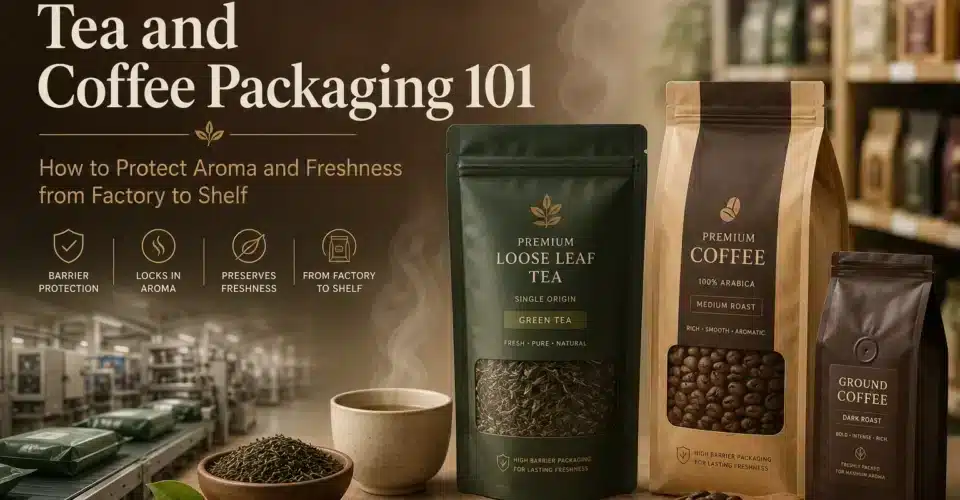
Tea and coffee are two of the most aroma-dependent products on any retail shelf. Unlike most packaged foods, where visual presentation or texture drives the buying decision, tea and coffee sell largely on a promise the customer can’t verify until they open the pack at home – freshness, aroma, and flavor that match what they experienced the first time they bought it. Get the packaging wrong, and even a genuinely excellent product tastes stale, flat, or “off” by the time it reaches the cup.
This guide breaks down exactly what happens to tea and coffee between factory and shelf, what threatens freshness at each stage, and what to actually look for in packaging built to protect aroma from the moment it’s sealed to the moment it’s brewed.
Why Tea and Coffee Are Uniquely Difficult to Package
Most packaged food products need protection from a handful of threats – moisture, physical damage, contamination. Tea and coffee face all of those, plus a fourth challenge that’s far more delicate: volatile aroma compounds. The complex flavor and scent profile that defines a quality tea or coffee comes from hundreds of aromatic compounds that begin degrading the moment the product is exposed to oxygen, light, moisture, or temperature fluctuation.
This is why packaging that would be perfectly adequate for, say, dried pasta or rice is often completely inadequate for tea or coffee – the bar for barrier performance is simply higher, because what’s being protected is more fragile and more central to the product’s actual value proposition.
The Four Threats to Tea and Coffee Freshness
1. Oxygen. Oxidation is the single biggest driver of staleness in both tea and coffee. It breaks down aromatic oils and compounds, dulling flavor and aroma over time – which is why oxygen barrier performance is often the single most important spec in tea and coffee packaging film.
2. Moisture. Both products are hygroscopic, meaning they readily absorb ambient moisture. For tea, this leads to loss of crispness and can encourage mold in extreme cases. For coffee, moisture accelerates staling and can compromise the beans’ structural integrity, affecting grind consistency and extraction.
3. Light. UV and visible light exposure degrades aromatic compounds and can affect color, particularly in green teas and lighter roast coffees, which tend to be more sensitive than darker, more processed products.
4. Temperature fluctuation. Repeated warming and cooling – common during shipping, warehouse storage, and retail display – accelerates the degradation of volatile compounds and can encourage condensation inside packaging, compounding the moisture problem.
What Happens to Coffee Specifically: The CO2 Problem
Coffee has one packaging challenge that tea doesn’t: freshly roasted beans continue releasing carbon dioxide for days or even weeks after roasting. This is why coffee packaging often includes a specific engineering solution – a one-way degassing valve that allows CO2 to escape without letting oxygen back in. Without this feature, sealed coffee packaging can bulge, or worse, seals can fail under internal pressure. Packaging without a degassing valve generally requires roasters to let beans “rest” before packaging, which adds time to the production timeline and isn’t always practical for high-volume operations.
Key Packaging Features That Actually Protect Aroma and Freshness
High-barrier, multi-layer film structures. Rather than a single material, effective tea and coffee packaging typically uses layered films combining different materials – each layer contributing a specific barrier property (oxygen resistance, moisture resistance, structural strength) that no single material provides on its own.
Foil or metallized layers. A foil or metallized barrier layer is one of the most effective ways to block both light and oxygen simultaneously, which is why premium tea and coffee packaging frequently includes this layer even when the outer packaging appears to be a standard pouch or bag.
One-way degassing valves (for coffee). As noted above, this is close to essential for whole bean or ground coffee packaged shortly after roasting.
Resealable closures. Since tea and coffee are rarely consumed in a single sitting, a genuinely effective reseal mechanism – a proper zipper, not just a fold-and-clip – significantly extends freshness after the customer opens the package, which directly affects how the product performs in the customer’s own kitchen, not just on the shelf.
Opaque or low-light-transmission materials. Especially relevant for lighter teas and light-roast coffees, where light sensitivity is higher – fully or partially opaque packaging materials reduce this risk considerably compared to clear or lightly tinted film.
Packaging Considerations by Product Type
Loose leaf tea generally requires stronger moisture and light protection than tea bags, since larger leaf surface area means more exposure to ambient air when the package is opened and reclosed repeatedly over its shelf life.
Tea bags benefit from individual wrapping (in addition to outer packaging) for products expected to have a long shelf life or inconsistent storage conditions, since this adds a layer of protection against moisture and aroma loss even after the outer package is opened.
Whole bean coffee requires reliable degassing valve performance and strong oxygen barriers, since whole beans have less surface area exposed than ground coffee and therefore stale more slowly – but still benefit significantly from high-barrier packaging to preserve that advantage.
Ground coffee stales considerably faster than whole beans due to increased surface area, making oxygen and moisture barrier performance even more critical, along with a genuinely effective reseal mechanism for repeated use.
From Factory to Shelf: Where Packaging Failures Actually Happen
Understanding the full supply chain journey helps explain why packaging specs that look sufficient in a lab test sometimes underperform in real-world conditions:
- Immediately post-production – the sealing process itself needs to be reliable and consistent; even excellent barrier film underperforms if seals aren’t fully secure
- Warehouse storage – extended storage periods, sometimes months, mean barrier properties need to hold up over time, not just at the point of packaging
- Transport – temperature fluctuations during shipping (particularly relevant for export shipments crossing different climates) stress packaging in ways that controlled factory conditions don’t reveal
- Retail display – shelf lighting, handling by customers, and open-and-close cycles from product sampling or damaged units all affect real-world freshness more than most brands initially plan for
- In-home storage after purchase – packaging that performs well until first opened but degrades quickly afterward creates a poor final impression, even if the product was genuinely fresh at the point of sale
Effective tea and coffee packaging is designed with this entire journey in mind – not just optimized for how the product looks and performs the day it leaves the factory.
Sustainability Considerations for Tea and Coffee Packaging
Tea and coffee brands increasingly face customer and retailer pressure to reduce packaging’s environmental footprint, which creates a genuine engineering trade-off: many of the most effective barrier materials (like certain foil laminates) are more difficult to recycle than simpler, single-material films. A few approaches brands are exploring:
- Mono-material barrier films that achieve strong barrier performance using a single recyclable material family, simplifying end-of-life recycling compared to traditional multi-material laminates
- Right-sizing packaging to match actual product volume, reducing material use without compromising barrier performance
- Working with certified sustainable manufacturers whose production processes themselves reduce environmental impact, even when the packaging material itself has barrier requirements that limit recyclability
This is an evolving area, and the right balance between barrier performance and sustainability depends heavily on the specific product, its expected shelf life, and the brand’s sustainability priorities – worth discussing directly with your packaging manufacturer rather than assuming a one-size-fits-all sustainable solution exists.
Questions to Ask When Evaluating Tea or Coffee Packaging
- What is the actual oxygen transmission rate (OTR) and moisture vapor transmission rate (MVTR) of this film structure, and is it appropriate for my product’s expected shelf life?
- For coffee: does this packaging include a reliable one-way degassing valve, and has it been tested for seal integrity under CO2 pressure?
- How does this packaging perform after multiple open-and-close cycles, not just at first opening?
- What real-world testing (not just lab specs) has been done to validate performance through typical shipping and storage conditions?
- What are the recyclability or sustainability trade-offs of this specific film structure compared to alternatives?
Frequently Asked Questions
Why does coffee packaging need a valve but tea packaging doesn’t?
Freshly roasted coffee continues releasing carbon dioxide for days or weeks after roasting, which a one-way degassing valve safely releases without letting oxygen back in. Tea doesn’t undergo this same post-production off-gassing process, so it doesn’t require this feature.
How long can tea and coffee stay fresh in properly designed packaging?
This varies significantly by product type, roast level, and packaging quality, but high-barrier packaging with reliable seals and, where relevant, degassing valves can meaningfully extend shelf life compared to standard packaging – though “fresh” is also a matter of degree, since aroma compounds begin degrading gradually from the moment of production regardless of packaging quality.
Does resealable packaging really make a difference after the customer opens it?
Yes, significantly. A large portion of a product’s total aroma and freshness exposure happens after the customer opens it, since most tea and coffee products aren’t consumed in one sitting. A genuinely effective reseal mechanism is one of the highest-impact features for real-world customer experience, not just a convenience add-on.
Is foil packaging necessary, or can other materials achieve the same protection?
Foil and metallized layers are among the most effective barriers against light and oxygen, but multi-layer film structures using other materials can also achieve strong barrier performance depending on the specific layer combination – the right choice depends on your product’s sensitivity, expected shelf life, and sustainability priorities.
Bottom Line
Tea and coffee packaging has to do more than just hold the product – it has to actively defend against oxygen, moisture, light, and temperature fluctuation from the moment it’s sealed until the last cup is brewed, potentially weeks or months later. Understanding these threats, and the specific engineering solutions that address each one, is what separates packaging that merely contains the product from packaging that actually protects the experience customers are paying for.
Vista Packaging designs and manufactures custom tea and coffee packaging solutions – including high-barrier multi-layer films, degassing valve integration, and resealable formats – engineered to protect aroma and freshness from factory to shelf. Get in touch with Vista Packaging to discuss packaging built around your product’s specific freshness requirements.