

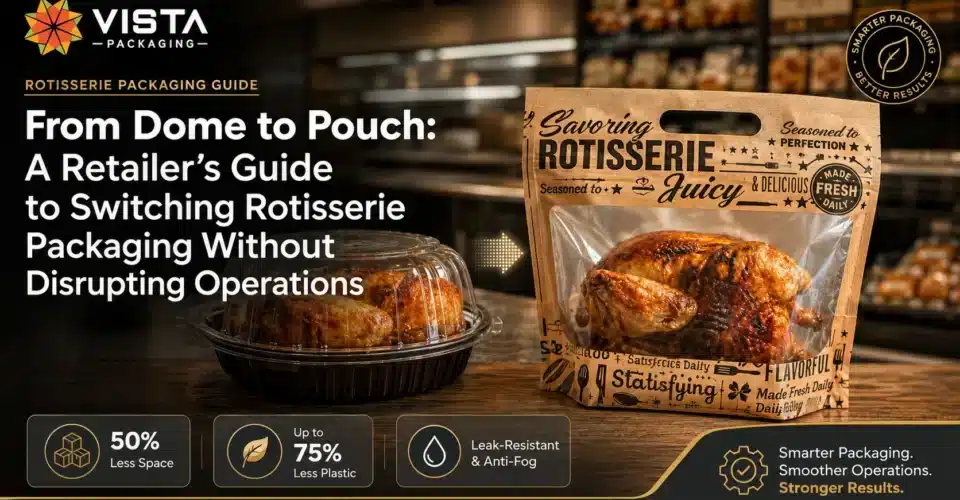
Rotisserie chicken is one of the highest-margin, highest-velocity items in a supermarket’s hot food section – which is exactly why so many retailers hesitate to change anything about how it’s packaged. The dome container has been the default for decades. It works. It’s familiar to staff, customers, and suppliers alike. Switching feels risky when the category is already performing well.
But that hesitation is increasingly costly. Dome packaging is bulkier to store, more expensive to ship, generates more plastic waste, and takes up significantly more shelf and back-of-house space than flexible pouch alternatives. Retailers who’ve made the switch – including major chains that have publicly reported plastic reductions of up to 75% by moving from domes to pouches – have found that the operational disruption is far smaller than expected, when the transition is planned properly.
This guide walks through exactly how to make that switch without disrupting hot food operations, staff workflows, or the customer experience that keeps rotisserie chicken selling.
Why Retailers Are Making the Switch
Before getting into the how, it’s worth being clear on the why – because understanding the actual operational drivers makes the transition plan itself much easier to justify internally.
Space efficiency. Pouches have a significantly slimmer profile than rigid dome containers, which means more product fits in the same storage, transport, and display space – both in the hot case and in backstock.
Lower shipping and storage costs. Flexible packaging weighs less and stacks more efficiently than rigid containers, reducing freight costs and warehouse footprint – a meaningful line-item saving at scale.
Reduced plastic waste. Pouches use substantially less material than domes to achieve the same product protection, aligning with both sustainability commitments and, increasingly, packaging regulations in various markets.
Better product presentation. Anti-fog film technology keeps the pouch clear even under hot, humid conditions, so the product stays visible and appealing – without the condensation buildup common with dome lids.
Reduced mess and complaints. Leak-resistant pouch seals address one of the most common customer complaints with dome packaging – grease escaping from loose-fitting lids during transport.
Step 1: Audit Your Current Rotisserie Workflow Before Changing Anything
Before selecting a pouch supplier or format, map out exactly how rotisserie chicken currently moves through your operation – from oven to shelf to customer. This includes:
- How staff currently package chicken coming off the rotisserie (temperature, timing, handling)
- How long product typically sits in the hot case before purchase
- Current labeling and pricing workflow (manual labeling vs. automated systems)
- How staff currently handle product that doesn’t sell within the hot-hold window
This audit matters because it tells you exactly where a packaging change will touch your existing process – and where it won’t. Many retailers assume a packaging switch requires an entirely new workflow, when in practice only one or two steps typically need adjustment.
Step 2: Choose the Right Pouch Format for Your Volume and Setup
Not all rotisserie pouches are the same, and matching the format to your actual operation matters more than defaulting to whatever a supplier pushes first.
Consider:
- Microwave compatibility – relevant if your store offers a reheat option or if customers expect to reheat directly in the packaging at home
- Resealable zipper features – useful for larger format chickens or multi-piece packs where customers may not consume the whole product immediately
- Handle and grab-point design – affects both customer convenience and how easily staff can move product from the hot case to the register
- Barrier and heat retention performance – ensures product stays hot and fresh through the typical in-store hold time, not just immediately after packaging
Requesting physical samples and running them through your actual hot-hold conditions – not just a supplier’s demo – is the best way to confirm a format works for your specific setup before committing to a full order.
Step 3: Pilot in a Small Number of Stores Before a Full Rollout
Rather than switching an entire chain’s rotisserie packaging simultaneously, a phased pilot significantly reduces operational risk. A typical pilot approach:
- Select 3–5 representative stores (varying by volume, staff experience level, and store format)
- Run the pilot for 2–4 weeks, tracking both operational metrics (packaging time, spoilage/waste, staff feedback) and customer-facing metrics (complaints, sales velocity, returns)
- Use pilot feedback to refine staff training materials and packaging specifications before wider rollout
This staged approach catches workflow friction points early – while they’re limited to a handful of stores – rather than discovering them during a chain-wide transition.
Step 4: Train Staff on the Physical Handling Difference
The most common operational friction in a dome-to-pouch switch isn’t the packaging itself – it’s the muscle memory of staff who’ve packaged rotisserie chicken the same way for years. A few areas that typically need brief, targeted training:
- Loading technique – pouches require a different hand motion than dropping a chicken into a rigid dome base
- Sealing process – whether pouches are heat-sealed, pre-sealed with a closure, or use another mechanism specific to your chosen format
- Hot-case placement – pouches may sit or stack differently in existing display equipment than dome containers did
- Handling during busy periods – staff need to be comfortable with the new format under peak-hour pressure, not just during a quiet training session
Most retailers find this training takes far less time than anticipated – often a single shift’s worth of hands-on practice – since the underlying task (get hot chicken from oven to packaged, labeled product) doesn’t fundamentally change.
Step 5: Address Customer-Facing Communication (If Needed)
For a product customers buy weekly or even daily, a visible packaging change can prompt questions – even when the change is a clear improvement. Consider:
- Brief signage near the hot case noting the packaging update, particularly if you’re highlighting a sustainability angle (reduced plastic waste is often a well-received message)
- Ensuring reheating instructions are clearly printed on the new packaging if microwave compatibility is a feature, since customer habits around dome containers may not transfer automatically
- Briefing customer service or front-line staff on how to answer basic questions about the change, so it doesn’t create friction at checkout
In most cases, customer response to a well-executed pouch switch is neutral to positive – particularly once shoppers notice less grease leakage and easier handling – but a small amount of proactive communication smooths the transition.
Step 6: Monitor Performance After Full Rollout
Once the switch is complete chain-wide, track the same metrics established during the pilot phase to confirm the transition is delivering the expected operational and cost benefits:
- Packaging and labor time per unit
- Shrink/waste rates
- Customer complaint volume related to packaging
- Shipping and storage cost changes
- Sell-through rate and any shift in average purchase size (some retailers see multi-piece purchases increase with resealable formats)
This data also becomes useful internally – both to justify the transition to stakeholders after the fact, and to inform decisions about extending similar packaging changes to other hot food categories.
Common Concerns Retailers Raise – and What Actually Happens
“Will staff resist the change?”
Most resistance comes from uncertainty, not the format itself. Clear, hands-on training during the pilot phase typically resolves this within days, not weeks.
“Will customers notice and complain?”
Some will notice – most won’t mind, and many respond positively once they experience less leakage and easier carrying. A brief in-store note framing the change (especially the sustainability angle) generally heads off confusion.
“Will product quality or presentation suffer?”
Modern rotisserie pouches with anti-fog film and heat-retention barrier technology are specifically engineered to match or exceed dome performance on visibility and freshness – this is worth verifying with samples before rollout, but it’s rarely a genuine trade-off with quality pouch suppliers.
“Is the switch worth the operational effort?”
For most mid-to-large retailers, the space savings, shipping cost reduction, and waste reduction deliver a return that outweighs the one-time transition effort – particularly once the pilot phase confirms the workflow adjustments are manageable.
Frequently Asked Questions
How long does a full dome-to-pouch transition typically take for a multi-store retailer?
Timeline varies by chain size, but a phased approach – pilot, refinement, then rollout – commonly spans 8–12 weeks from initial pilot to full chain-wide implementation, allowing time for staff training and process refinement at each stage.
Do rotisserie pouches work with existing hot-case display equipment?
In most cases, yes, though it’s worth confirming with your supplier and testing during the pilot phase, since pouch dimensions and stacking behavior differ from rigid dome containers.
Is switching to pouch packaging more expensive than continuing with domes?
Per-unit packaging cost varies by supplier and volume, but many retailers find that reduced shipping costs, storage space savings, and lower material waste offset or exceed the packaging cost difference – which is why tracking total operational cost, not just per-unit packaging price, gives a more accurate picture.
Can pouches maintain the same heat retention as dome containers?
Quality rotisserie pouches are specifically engineered with barrier films that conform closely to the product, which can improve heat retention compared to domes by reducing the air gap around the chicken – though performance should be verified through real-world sample testing for your specific hold times.
Bottom Line
Switching from dome to pouch rotisserie packaging is less disruptive than most retailers expect – when it’s approached as a phased operational project rather than an overnight change. A clear workflow audit, the right pouch format for your volume, a small pilot before full rollout, and focused staff training are what separate a smooth transition from a chaotic one. The operational and sustainability upside – less plastic waste, lower shipping costs, better space efficiency – makes this one of the more straightforward high-impact changes available in the hot food category.
Vista Packaging works with supermarkets, deli chains, and food-service operators to plan and execute rotisserie packaging transitions, from format selection through pilot support and full-scale supply. Get in touch with Vista Packaging to discuss a phased switch to rotisserie pouches for your stores.