

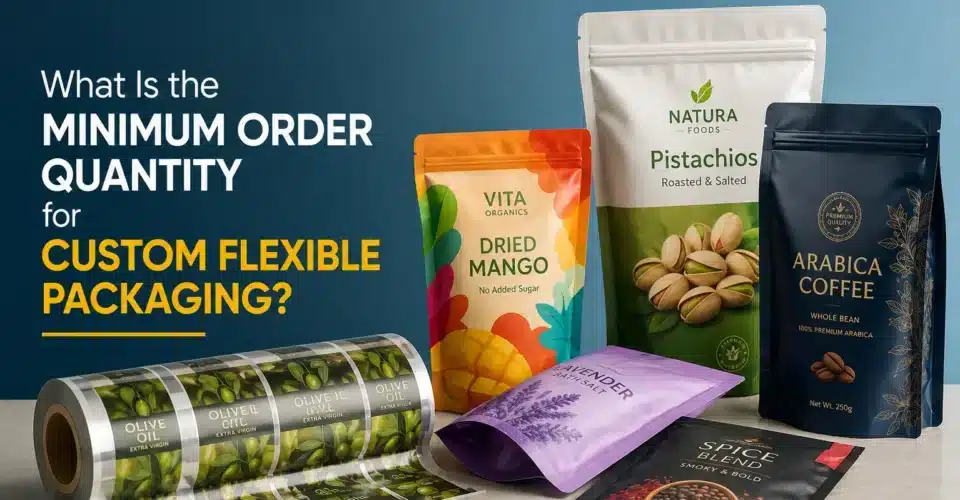
It’s usually one of the first practical questions a brand asks once they’ve decided to move forward with custom packaging – and one of the most misunderstood. Minimum Order Quantity (MOQ) can make or break whether custom packaging is even feasible for a smaller brand, and yet it’s rarely explained clearly upfront.
The honest answer is that MOQ isn’t a fixed number – it depends on materials, print complexity, and the manufacturer’s production setup. This guide breaks down what actually determines MOQ for custom flexible packaging, why it varies so much between suppliers, and how to plan your order size sensibly whether you’re a startup ordering your first run or an established brand scaling up.
Why MOQ Exists in the First Place
Minimum order quantities aren’t arbitrary – they exist because of how flexible packaging is actually manufactured. Custom printing requires setting up print plates or cylinders, calibrating machinery for a specific film structure, and running production lines that are most efficient at certain volumes. Below a certain quantity, the setup cost and time per unit becomes disproportionately high for the manufacturer, which is why MOQs exist to keep custom production commercially viable for both sides.
Understanding this helps explain why MOQ varies so much – it’s directly tied to how much setup a particular design and material combination requires, not an arbitrary supplier policy.
What Determines MOQ for Custom Flexible Packaging
1. Print complexity. A single-color print requires far less setup than a full-color, multi-layer design. More colors and more intricate graphics generally mean higher MOQs, since the plate/cylinder setup cost is spread across the order.
2. Material and film structure. Standard, commonly-stocked films typically carry lower MOQs than specialized barrier films, multi-layer laminates, or films sourced specifically for a project. Unique material combinations often require larger minimum runs to justify sourcing.
3. Pouch or format complexity. A simple flat or standard pouch format generally has a lower MOQ than a complex format with special features – resealable zippers, spouts, unusual die-cut shapes, or added functional elements like tear notches and hang holes.
4. Number of SKUs or variants. If you’re launching multiple flavors, sizes, or product variants at once, each variant with different artwork may carry its own MOQ – which can multiply your total order commitment quickly if not planned carefully.
5. Sustainability or specialty certifications. Packaging using recyclable, compostable, or other sustainable materials sometimes carries different MOQ thresholds than conventional films, depending on how those materials are sourced and processed.
Typical MOQ Ranges (General Industry Patterns)
While exact figures vary by manufacturer and project specifics, custom flexible packaging MOQs generally fall into broad tiers:
- Standard format, simple print, common film: typically the most accessible tier for smaller brands and startups
- Custom format or multi-color print: a moderate step up, reflecting the added plate and material setup
- Highly specialized structures (multi-layer barrier film, unique die-cut shapes, specialty sustainable materials): typically the highest tier, since sourcing and setup costs are more significant
Always confirm exact MOQ figures directly with your manufacturer for your specific design and material combination – general ranges are a starting point for budgeting, not a substitute for a real quote.
What Smaller Brands Can Do When MOQ Feels Out of Reach
MOQ is one of the biggest early hurdles for startups and smaller food or FMCG brands. A few practical approaches worth considering:
- Start with a simpler design. A single or two-color print on a standard pouch format typically carries a lower MOQ than a complex, full-color custom shape – and can always be upgraded once volume grows.
- Reduce SKU count for your first order. Launching with one or two core variants instead of five spreads your total commitment across fewer individual MOQs, rather than multiplying it.
- Ask about semi-custom options. Some manufacturers offer stock pouch formats with custom printing only, which can carry a lower MOQ than a fully custom structure and print combination.
- Talk to your manufacturer directly about your growth plans. Manufacturers who understand you’re planning to scale – and reorder – are sometimes more flexible on a first order than a one-time buyer, since the relationship has long-term value on both sides.
MOQ vs. Total Cost: Why Higher MOQ Isn’t Always Bad
It’s worth reframing MOQ from a purely restrictive lens. Larger order volumes typically bring down the per-unit cost significantly, since setup costs are fixed regardless of order size and get spread across more units. This means a brand ordering at or above the MOQ threshold is often getting meaningfully better unit economics than they would from a smaller, more “flexible” order – which matters for margins once the product is actually selling.
The real planning question isn’t just “what’s the lowest MOQ I can find,” but “what order size actually makes sense for my sales velocity and storage capacity” – ordering far more than you can sell or store within a reasonable shelf-life window creates its own costs, even if the per-unit price looks attractive.
Questions to Ask Your Packaging Supplier About MOQ
- What is the MOQ for this specific film structure and print complexity – not just a general company minimum?
- Does MOQ apply per SKU/variant, or across a combined order?
- Is there a lower MOQ option for a first order or sample-to-market run, with standard MOQ applying to reorders?
- How does MOQ change if I switch to a more common material or simpler format?
- What’s the typical unit cost difference between the minimum order and a mid-range order size?
Asking these questions upfront avoids surprises later in the design process, when switching formats or materials to hit a lower MOQ becomes a much bigger disruption than addressing it during initial planning.
Frequently Asked Questions
Is MOQ the same for every type of flexible packaging?
No. MOQ depends on the specific combination of material, print complexity, and format – a standard preformed pouch with simple print will generally have a different (usually lower) MOQ than a multi-layer barrier film with complex custom die-cutting.
Can I order below the stated MOQ?
Some manufacturers offer below-MOQ options at a higher per-unit cost to accommodate sampling, market testing, or very small brands, though this isn’t universal. It’s worth asking directly, particularly if you’re testing a new product before committing to a full production run.
Does MOQ apply separately to each product variant or flavor?
Typically yes, if each variant has different artwork or specifications, since each requires its own print setup. Brands launching multiple SKUs at once should factor this into total order planning rather than assuming one combined MOQ covers all variants.
Why do sustainable packaging materials sometimes have different MOQs?
Some sustainable or specialty materials are sourced in different quantities or require different processing than conventional films, which can affect minimum order thresholds. This varies significantly by material and supplier, so it’s worth confirming directly during the discovery conversation.
Does reordering the same design have a different MOQ than a first order?
Reorders of an already-approved design sometimes have more flexibility, since the design and tooling investment is already made. It’s still worth confirming with your manufacturer, as production efficiency considerations can still apply.
Bottom Line
MOQ for custom flexible packaging isn’t a fixed industry number – it’s shaped by print complexity, material choice, format, and how many variants you’re launching at once. Understanding what actually drives MOQ gives you real leverage in planning a first order that fits your budget and growth stage, rather than treating the minimum quantity as a fixed obstacle. The right approach is usually to work backward from your actual sales and storage capacity, not just chase the lowest number available.
At Vista Packaging, we work with brands at every stage – from first-time custom orders to established FMCG and food brands scaling production – to find a packaging format, material, and order size that fits both budget and growth plans. Get in touch with Vista Packaging to discuss MOQ for your specific project and get a realistic quote based on your requirements.