

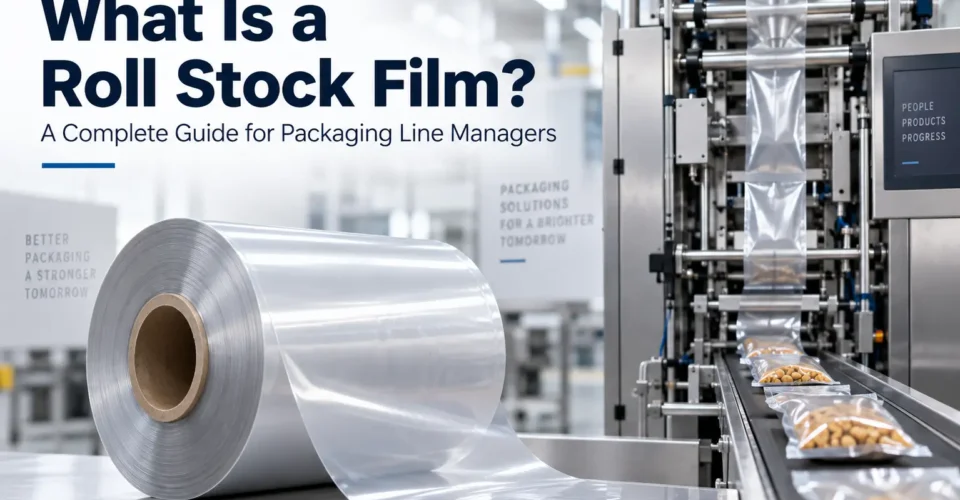
If you run a packaging line – or you’re evaluating suppliers for one – you’ve probably come across the term “roll stock film” more times than you can count. It’s one of those phrases that gets used constantly in flexible packaging conversations, yet rarely gets properly explained. This guide breaks down exactly what roll stock film is, how it works on your machinery, what goes into choosing the right structure, and how to avoid the most common mistakes buyers make when sourcing it.
What Is a Roll Stock Film?
Roll stock film is flexible packaging material supplied in large, continuous rolls rather than as pre-made bags or pouches. It’s designed to be fed directly into form-fill-seal (FFS) machines, where it is automatically formed into a pouch, filled with product, and sealed – all in one continuous, high-speed process.
Instead of buying empty pouches that someone then has to load by hand or on a separate filling line, roll stock film lets manufacturers form the package and fill it in a single pass. That’s why it’s the packaging format of choice for high-volume food, beverage, and industrial production lines.
How Roll Stock Film Works on a Packaging Line
Roll stock film is engineered to run on two main types of FFS equipment:
- Vertical Form-Fill-Seal (VFFS): The film is fed vertically, formed into a tube, filled from the top, and sealed at the bottom and top – commonly used for snacks, powders, granules, and liquids.
- Horizontal Form-Fill-Seal (HFFS): The film runs horizontally and is typically used for flow-wrap applications like bars, baked goods, and individually wrapped items.
For roll stock film to perform well on either type of equipment, it needs the right combination of properties: consistent thickness, reliable seal integrity at high speeds, and dimensional stability so it doesn’t stretch, wrinkle, or misalign as it runs through the machine. This is why not all films are interchangeable – a film built for a slow horizontal wrapper won’t necessarily perform on a fast vertical filler, and vice versa.
What Roll Stock Film Is Made Of
Modern roll stock film is rarely a single layer of plastic. It’s typically a multilayer laminate, where each layer contributes a specific function:
- Outer layer – carries the print and provides gloss, matte, or combination finishes for shelf appeal
- Barrier layer – protects against oxygen, moisture, and light to preserve freshness (this is where metallised or clear laminations come in)
- Sealant layer – the innermost layer that actually bonds the pouch together during sealing
These layers are bonded together using lamination techniques, with solvent-less lamination increasingly preferred across the industry. It reduces solvent residue and volatile organic compound (VOC) emissions during manufacturing, which matters both for food safety and for brands trying to reduce their environmental footprint.
Key Factors to Consider When Choosing Roll Stock Film
If you’re specifying or sourcing roll stock film for your line, these are the variables that actually matter:
1. Machine compatibility Confirm whether your equipment is vertical or horizontal FFS, and share your machine specifications (speed, sealing bar temperature, film width) with your supplier before finalizing a structure.
2. Barrier requirements A dry snack needs different oxygen and moisture barrier properties than a wet, refrigerated, or high-fat product. Under-specifying barrier performance is one of the most common (and costly) mistakes brands make.
3. Print and finish Roll stock film can be fully printed with matte, glossy, or combination finishes, and produced in metallised or clear laminations depending on whether you want a premium metallic look or full product visibility through the pack.
4. Seal strength and speed Faster lines put more stress on seals. The film’s sealant layer needs to be matched to your line speed to avoid leakers, seal failures, or downtime from jams.
5. Sustainability goals If recyclability or reduced material use is a priority, ask your supplier about mono-material structures and lighter-gauge films that still meet your barrier and strength requirements.
Roll Stock Film vs. Preformed Pouches
A question we hear often: should you run roll stock film through your own FFS equipment, or buy preformed pouches that are filled separately? The short answer is that it depends on your production volume, existing equipment, and flexibility needs.
Roll stock film generally makes sense when you have (or plan to invest in) FFS machinery and want to minimize per-unit packaging cost at scale. Preformed pouches make more sense for lower volumes, multiple SKUs, or when you need packaging formats – like stand-up pouches with zippers – that aren’t practical to form in-line.
(For a deeper breakdown, see our comparison: Preformed Pouches vs. Form-Fill-Seal: What’s Right for Your Packaging Line?)
Common Roll Stock Film Applications
Roll stock film is used across a wide range of categories, including:
- Snack foods and confectionery
- Coffee and tea (with degassing valve integration where needed)
- Bakery products
- Frozen and refrigerated foods
- Pharmaceutical and nutraceutical products
- Industrial and household goods
Each of these categories comes with its own barrier, seal, and shelf-life requirements, which is why custom film structures – rather than one-size-fits-all films – tend to perform best.
Why Work with a Custom Roll Stock Film Manufacturer
Off-the-shelf film can work for basic applications, but most brands eventually run into a limitation – whether it’s a barrier property that isn’t quite right, a print finish that doesn’t match their brand, or a seal that underperforms on their specific machine. A manufacturer that builds bespoke multilayer structures can tailor the film to your exact FFS equipment, product sensitivity, and sustainability targets, rather than asking you to adapt your product to a generic film.
At Vista Packaging, we design custom roll stock film structures using modern solvent-less lamination techniques, available in matte, glossy, or combination finishes, and in metallised or clear laminations – engineered to run reliably on both vertical and horizontal FFS equipment. Explore our Roll Stock Film solutions →
Frequently Asked Questions
What is the difference between roll stock film and a preformed pouch?
Roll stock film is supplied as a continuous roll and formed into a pouch on your own FFS machine during filling. A preformed pouch already exists as a finished bag before filling and requires separate loading.
Can roll stock film be recycled?
It depends on the structure. Multilayer laminates with mixed materials are harder to recycle than mono-material structures. If recyclability is a priority, ask your supplier about mono-material or reduced-layer film options.
What thickness should roll stock film be?
Thickness depends on the product being packed, the barrier requirements, and the machine’s sealing parameters. There’s no universal standard – it should be specified based on your product and line, not assumed.
Does roll stock film work on both vertical and horizontal FFS machines? Yes, but the film structure needs to be engineered for the specific machine type, since vertical and horizontal FFS equipment place different mechanical and sealing demands on the film.
Ready to specify the right roll stock film for your line? Contact Vista Packaging to discuss your product, equipment, and sustainability requirements.