

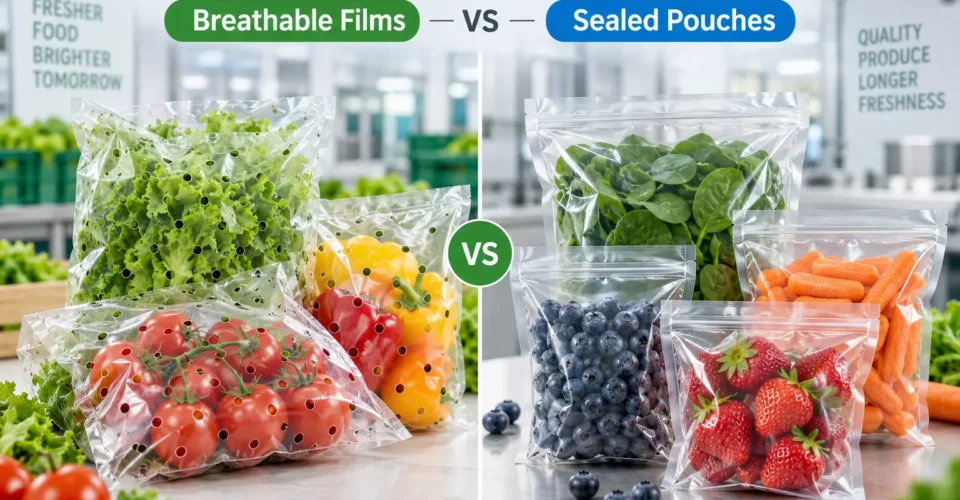
There’s a fundamental fork in the road in fresh fruits & vegetable packaging, and most brands hit it early: should the pack let air move in and out, or should it be sealed shut?
It sounds like a simple binary. It isn’t. The right answer depends on what your product is doing biologically after harvest, how long it needs to survive in the supply chain, and what “failure” looks like for that specific item – wilting, mold, bruising, or off-flavors. Get the choice wrong and packaging actively accelerates the spoilage it was meant to prevent.
This guide walks through how to think about that decision.
First, the thing that makes produce different
Fresh fruits and vegetables are still alive after harvest. They continue to respire – taking in oxygen, giving off carbon dioxide and water vapor – right up until they’re eaten.
Everything about fresh fruits & vegetable packaging follows from that single fact. A packet of biscuits just needs to be kept away from moisture and air. A punnet of strawberries is generating moisture and consuming oxygen from inside the pack, continuously, for its entire shelf life. Your packaging has to manage an environment that’s actively changing.
That’s why the breathable-vs-sealed question exists at all. You’re deciding whether to let that internal environment vent, or to control it.
What “breathable” actually means
Breathable produce packaging allows a controlled exchange of gases between the inside of the pack and the outside air. In practice this usually means micro-perforations in the film – tiny holes, precisely sized and spaced, that let oxygen in and let CO2 and excess moisture out.
The critical word there is controlled. Breathable doesn’t mean “open.” A bag with a few large holes punched in it is not breathable packaging; it’s just a bag with holes, and it will dry your product out. Proper breathability is calibrated: the perforation size and density are matched to how fast that specific product respires.
Breathability tends to be the right approach when:
- The product respires quickly and would suffocate in a sealed environment
- Condensation is your main enemy – trapped moisture leading to mold or slime
- The product is sold fast and doesn’t need an extended controlled atmosphere
- You need to avoid anaerobic conditions that cause fermentation and off-flavors
What “sealed” actually means
A sealed pouch closes the pack off from outside air entirely. On its own, that’s usually a bad idea for fresh produce – a living product in an airtight bag will eventually consume all the oxygen, switch to anaerobic respiration, and develop off-flavors and soft rot.
Sealed produce packaging almost always means sealed plus atmosphere management. That’s Modified Atmosphere Packaging: the gas mix inside the pack is deliberately adjusted at the point of sealing to slow respiration down, rather than simply trapping ordinary air.
Sealing tends to be the right approach when:
- The supply chain is long and shelf life needs to be stretched significantly
- The product is prone to moisture loss and needs humidity retained
- You need barrier protection against outside contamination
- Slowing ripening is the primary goal
The two are not actually opposites
Here’s where the framing of “breathable vs sealed” breaks down a little, and it’s worth being honest about it: the best produce packaging is very often both.
A sealed MAP pouch with precisely calibrated laser micro-perforation gives you the atmosphere control of sealing and the fine-tuned gas exchange of breathability. The perforation acts as a regulator, letting the pack self-correct rather than drifting toward an atmosphere that’s too low in oxygen.
So the real question usually isn’t “breathable or sealed.” It’s how much exchange the pack should permit, and how tightly the internal atmosphere should be controlled. Those are dials, not switches.
Vista Packaging’s produce packaging solutions combine MAP with precision laser perforation for exactly this reason – the two technologies solve different halves of the same problem.
A practical way to decide
If you’re specifying packaging for a produce line, work through these in order:
1. How fast does the product respire?
High-respiration items (leafy greens, broccoli, mushrooms) generate CO2 and moisture quickly and need meaningful gas exchange. Low-respiration items (root vegetables, apples, citrus) tolerate much tighter packaging.
2. What kills this product first?
Be specific. Is it dehydration and wilting? Mold from condensation? Bruising? Over-ripening? Each failure mode points toward a different packaging response, and they sometimes pull in opposite directions.
3. How long is the journey?
A product sold locally within 48 hours has very different needs from one moving through cold storage, export shipping, and retail distribution over three weeks. Longer chains generally justify stronger atmosphere control.
4. Is the product whole or cut?
Cut produce has vastly more exposed surface area, respires faster, and carries higher food-safety stakes. It almost always needs more intervention than the equivalent whole product.
5. What does it need to look like on the shelf?
Condensation on the inside of a clear film makes a perfectly good product look unappetizing. Visual presentation is a genuine functional requirement in produce, not a cosmetic afterthought.
Symptoms of getting it wrong
If you’re already packing produce and something isn’t working, the symptoms usually point at the cause:
| What you’re seeing | Likely issue |
| Condensation, fogging, mold | Not enough gas/moisture exchange – pack is too closed |
| Wilting, shriveling, weight loss | Too much exchange – product is drying out |
| Off-flavors, fermented smell, soft rot | Oxygen depleted inside pack – anaerobic respiration |
| Premature ripening, short shelf life | No atmosphere control where the supply chain needs it |
| Product looks fine but fails late in the chain | Packaging tuned for the wrong shelf-life window |
None of these are film-quality problems. They’re specification problems – the packaging is performing exactly as designed, and the design was matched to the wrong product behavior.
Why generic produce film underperforms
It’s common for brands to use one film spec across an entire produce range because it simplifies purchasing. The trade-off is that a perforation level tuned for salad leaves will dry out carrots, and a spec that works for carrots will suffocate the salad.
Because respiration rates vary so much between produce types – and even between ripeness stages of the same product – packaging specifications generally need to be set per product line rather than per brand. That’s the single biggest lever most produce brands have for reducing spoilage, and it costs nothing structural to fix; it’s a specification decision, not a capital investment.
The sustainability layer
Produce packaging draws more consumer scrutiny than almost any other category, largely because the product underneath looks like it shouldn’t need packaging at all.
Worth keeping in perspective: packaging that extends usable shelf life reduces food waste, and wasted food carries a considerably larger environmental footprint than the film that would have prevented it. The goal isn’t less packaging in the abstract – it’s the least packaging that still does the job, in the most recoverable material available.
That’s where compostable films and recyclable mono-material structures come in. Both are viable for many produce applications, but they involve real performance trade-offs that need testing against your specific shelf-life requirements rather than being assumed.
Frequently Asked Questions
Can I use the same film for all my produce lines?
You can, but you’ll almost certainly be over-packaging some products and under-packaging others. Respiration rates differ enough between produce types that per-line specification is usually worth the added complexity.
Does breathable packaging shorten shelf life compared to sealed?
Not inherently. For high-respiration products, breathable packaging often extends shelf life relative to a poorly specified sealed pack, because it prevents the anaerobic conditions that cause rapid deterioration.
Why is there condensation inside my produce bags?
The pack isn’t venting the moisture the product is generating. This is usually a perforation specification issue rather than a film defect.
Is perforated film still protective against contamination?
Micro-perforations are extremely small and still provide a substantial physical barrier, though a perforated pack offers less isolation than a fully sealed one. For products where contamination risk is the governing concern, sealed MAP is generally preferred.
Do organic and conventional produce need different packaging?
Biologically, no – respiration and moisture behavior are the same. Organic brands often prioritise compostable or recyclable materials for positioning reasons, but the underlying technical requirements don’t change.
Not sure which approach fits your fresh fruits & vegetable packaging line? Respiration rate, supply chain length, and failure mode all need to be weighed together. Talk to Vista Packaging about specifying the right film for your specific product.