

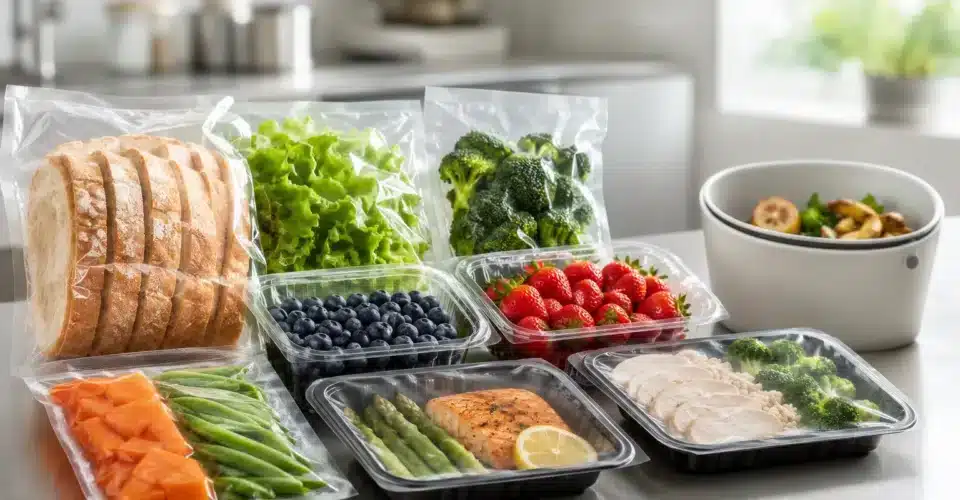
Food waste doesn’t start at the dinner table – it starts long before that, in trucks, warehouses, and retail coolers where products spoil before they’re ever sold. For brand owners and procurement teams, that spoilage shows up as chargebacks, shrink, and lost margin. Food shelf-life extension packaging addresses this problem directly by slowing the biological and chemical processes that cause food to degrade, giving products more time to move through the supply chain intact.
This post breaks down how shelf-life extension packaging actually works, which formats fit which products, and what US-based buyers should evaluate when sourcing from an international manufacturer.
Why Food Spoils – and Where Packaging Intervenes
Food degrades through a combination of factors: oxygen exposure (oxidation, rancidity, mold growth), moisture migration, microbial activity, and light exposure. Conventional packaging often does little to control these variables beyond basic containment. Shelf-life extension packaging is engineered specifically to manage them, using barrier materials and, in many cases, modified atmospheres inside the pack itself.
The result isn’t just “packaging that looks nice on shelf” – it’s a functional tool that directly reduces the volume of product that gets pulled, discounted, or discarded before it reaches the consumer.
How MAP (Modified Atmosphere Packaging) Works
Modified Atmosphere Packaging (MAP) replaces the ambient air inside a pack with a controlled gas mixture – typically some combination of nitrogen, carbon dioxide, and oxygen, calibrated to the specific product. For example:
- Reducing oxygen levels slows oxidation and limits aerobic microbial growth, which is critical for products like rotisserie chicken, deli meats, and prepared meals.
- Adjusting CO2 concentration can inhibit mold and bacterial growth in bakery and produce items.
- Balancing gas ratios helps maintain color, texture, and moisture content, so products don’t just last longer – they look and taste like they should when the pack is opened.
This is why MAP has become standard for categories like rotisserie and prepared foods, where the gap between “cooked” and “sold” can otherwise mean significant spoilage risk. Vista Packaging’s MAP and shelf-life extension film is built around this principle, using barrier structures suited to different fat content, moisture levels, and storage conditions.
Packaging Formats and Where They Fit
Not every product needs the same barrier strategy. Matching format to product is where waste reduction actually happens.
| Packaging Format | Typical Use Case | Primary Waste-Reduction Mechanism |
| Rotisserie pouches | Hot-filled rotisserie chicken, prepared meats | Heat resistance, oxygen barrier, seal integrity |
| Produce packaging | Fresh fruits, vegetables | Breathable/MAP films that manage respiration rate |
| Snacks packaging | Chips, dried snacks, nuts | Moisture and oxygen barrier to prevent staleness/rancidity |
| Lidding films | Trays, cups, portioned foods | Seal integrity, puncture resistance, barrier lamination |
| Roll stock film | Form-fill-seal production lines | Consistent barrier performance at high production speeds |
| Preformed pouches | Ready-to-fill retail products | Standardized barrier with retail-ready presentation |
| Tea & coffee packaging | Ground coffee, loose tea | Aroma retention, moisture and light barrier |
| Bakery packaging | Bread, baked goods | Moisture control to delay staling and mold growth |
| Paper boards | Secondary/outer packaging | Structural protection, reduced product damage in transit |
What This Means for Waste Reduction in Practice
Shelf-life extension packaging reduces waste at several points in the supply chain, not just on the retail shelf:
- Fewer in-transit losses. Products with better barrier protection are less likely to spoil during long-haul or international shipping.
- Reduced retail shrink. Extended shelf life gives retailers a longer sell-through window before markdown or disposal.
- Lower return and chargeback rates. For private label and co-manufactured brands, spoilage-related returns directly affect supplier relationships and cost structures.
- Better inventory flexibility. Longer shelf life gives procurement and logistics teams more room to manage demand fluctuations without over-ordering or rushing shipments.
For brand owners managing multi-state or national distribution, this margin matters – every percentage point of shrink reduction has a direct line to profitability.
Regulatory and Compliance Considerations for US Buyers
Packaging that comes into direct contact with food sold in the US market needs to meet FDA food-contact compliance requirements. When sourcing packaging internationally, buyers should confirm:
- That the materials used are food-contact compliant for the specific product category (e.g., high-fat foods, acidic foods, dry goods)
- Documentation and material certifications are available for import and audit purposes
- The manufacturer can provide relevant traceability and quality documentation upon request
Vista Packaging manufactures under BRCGS, SMETA, and ISO 14001:2015 certifications from its facility in Vasai, India, and works with US-based brand owners and private label companies through export arrangements. Buyers should always confirm specific food-contact compliance documentation for their product category directly with the manufacturer before finalizing an order.
What to Evaluate When Sourcing Shelf-Life Extension Packaging
If you’re evaluating an international packaging supplier, a few criteria matter more than others:
- Barrier properties matched to your product – oxygen transmission rate (OTR) and moisture vapor transmission rate (MVTR) should be specified for your exact application, not treated as generic.
- Certifications – BRCGS and ISO 14001:2015 indicate food safety and environmental management systems are in place; SMETA reflects ethical and social compliance audits.
- MOQs and production capacity – confirm minimum order quantities align with your volume needs, especially for private label runs.
- Lead times and logistics – international sourcing means factoring in production time plus ocean or air freight; build this into your inventory planning.
- Sample and testing process – request samples tested under your actual product conditions (temperature, fat content, storage duration) before committing to a full run.
FAQ
What is food shelf-life extension packaging?
It’s packaging engineered with barrier materials – and often modified atmosphere technology – to slow oxidation, moisture loss, and microbial growth, extending the time a food product stays safe and sellable.
How does MAP differ from vacuum packaging?
Vacuum packaging removes air entirely, which can affect texture in some products. MAP replaces air with a specific gas blend calibrated to the product, which can better preserve appearance, texture, and moisture for items like rotisserie meats or baked goods.
Does shelf-life extension packaging work for all food categories?
No single format fits every product. Barrier requirements differ significantly between, for example, dried snacks and fresh produce, which is why format and film structure should be matched to the specific product’s oxygen, moisture, and handling needs.
Is packaging sourced from India suitable for US food-contact applications?
It can be, provided the materials meet FDA food-contact compliance requirements for the specific product category. Buyers should request documentation confirming this before finalizing orders.
How do I know which packaging format is right for my product?
The right starting point is sharing your product’s fat content, moisture level, expected storage duration, and distribution conditions with your packaging manufacturer so they can recommend a barrier structure and format suited to your specific shelf-life goals.
Get in Touch
Reducing food waste starts with packaging built for your product’s specific shelf-life challenges. Vista Packaging manufactures custom shelf-life extension solutions from its BRCGS, SMETA, and ISO 14001:2015-certified facility in Vasai, India, and works with US brand owners and private label companies through export. Explore our full range of sustainable packaging solutions or contact us to discuss your product’s barrier and shelf-life requirements.