

a golden, perfectly roasted chicken spins to a stop behind the deli counter. A customer’s eyes light up — but the moment it’s dropped into a flimsy, steaming bag that fogs up immediately and collapses under the weight, that excitement quietly dies. Your food deserves better. Your brand deserves better.
In the fiercely competitive world of food retail, rotisserie chicken is one of the highest-margin, highest-volume impulse buys a grocery store or deli can offer. And yet, one of the most overlooked factors in its success sits quietly on the shelf: the pouch it comes in.
Rotisserie pouches are not just packaging — they are a direct extension of your brand promise. The right pouch keeps heat locked in, juices contained, and customers coming back. The wrong one loses you sales before a single bite is taken.
In this guide, we’ll break down exactly how to design high-performance, custom rotisserie pouches that work as hard as your food does — and leave a lasting impression on every customer who picks one up.
Why Rotisserie Pouch Design Is More Critical Than You Think
Most food businesses spend months perfecting their recipe and seconds thinking about their packaging. That’s a costly mistake. Studies consistently show that packaging influences purchasing decisions in under 7 seconds at the point of sale — and for hot food, that number is even smaller.
Here’s what’s at stake every time a customer reaches for your rotisserie chicken:
- First impressions are packaging impressions. If the pouch looks cheap, customers assume the food is too.
- Heat retention = perceived freshness. A pouch that keeps food hot signals quality, even before the first bite.
- Leaks destroy brand trust. One greasy bag on a customer’s car seat can cost you that customer forever.
- Shelf visibility drives sales. Custom-printed pouches with bold branding outperform plain alternatives by up to 30%.
The good news? Getting rotisserie pouch design right is entirely within your control — and the difference it makes to both food quality and brand perception is dramatic.
The 5 Non-Negotiable Features of a High-Performance Rotisserie Pouch
Not all rotisserie pouches are created equal. Before you think about logos and colors, you need to nail the functional fundamentals. Here are the five features that separate average pouches from exceptional ones:
1. Superior heat retention
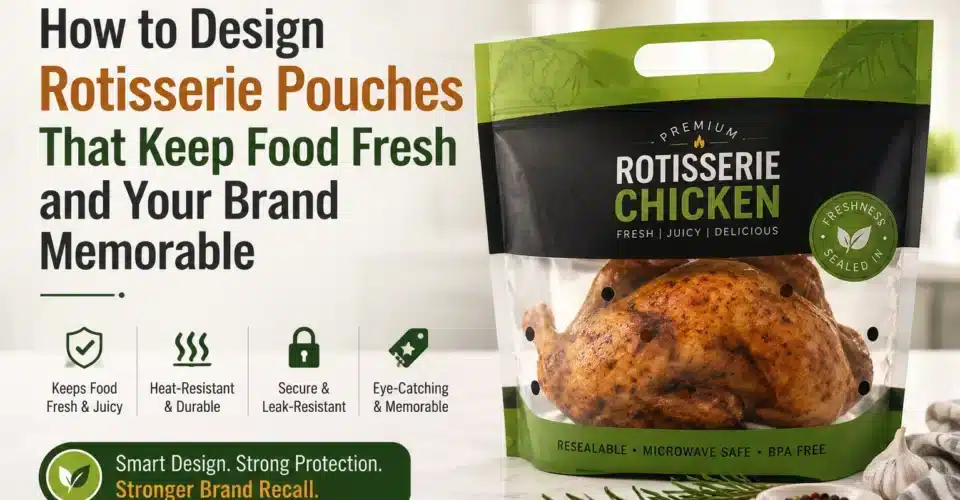
Your customers expect to bring home a hot meal. A pouch engineered with multi-layer barrier films traps heat significantly longer than standard alternatives — often keeping food at serving temperature for 30 to 45 minutes after purchase. Look for pouches with insulating inner layers and a tight, resealable seal.
2. Grease and moisture resistance
Rotisserie chicken is naturally juicy — that’s part of the appeal. But juices soaking through a bag are a nightmare for customers. High-quality pouches use grease-resistant coatings that prevent bleed-through while still allowing steam to vent safely, avoiding the dreaded soggy-skin problem.
3. Controlled venting
Steam build-up is the enemy of crispy skin. The best rotisserie pouches incorporate micro-venting technology that allows steam to escape at a controlled rate, maintaining just enough humidity to keep the meat moist without making the skin limp. This is one of the most technically demanding — and most valuable — features to get right.
4. Structural integrity
A pouch that collapses or tears under the weight of a whole chicken is worse than no pouch at all. Look for reinforced bottom gussets, high tensile-strength materials, and handles or grip zones that make carrying easy without risking a drop. A whole bird can weigh up to 1.5 kg — your packaging needs to handle that with confidence.
5. Food-safe, certified materials
All materials in contact with hot food must meet food safety standards — no exceptions. Ensure your supplier can provide certification for food-grade inks, adhesives, and film layers. At Vista Packagings, all rotisserie pouches are manufactured to meet global food safety compliance standards, giving you and your customers complete peace of mind.
Custom Branding: Turning Your Pouch Into a Marketing Asset
Once the functional requirements are locked in, the exciting part begins: making your rotisserie pouch a powerful brand touchpoint. Custom packaging is one of the most cost-effective marketing investments a food business can make. Here’s how to do it right:
Design with the shelf in mind
Your pouch will sit next to competitors’ products, often under harsh fluorescent lighting. Design for maximum visual contrast. Use your brand’s primary colors boldly, ensure your logo is positioned for visibility at eye level, and consider a window panel — transparent sections that let the golden color of the chicken sell itself.
Use typography that communicates quality
Font choices are surprisingly powerful psychological signals. Clean, modern sans-serif fonts suggest freshness and efficiency. Warm, slightly rounded typefaces suggest home-cooked comfort. Avoid thin, delicate fonts — they get lost on packaging and suggest fragility rather than confidence.
Tell your story in 10 words or fewer
Customers don’t read; they scan. Use the available panel space to communicate your most powerful message instantly. Examples that work:
- “Always fresh. Always hot.”
- “Slow-roasted. Fast to you.”
- “No shortcuts. Just flavor.”
These micro-copy moments build emotional connection in the fraction of a second a customer’s eye lands on your pack.
Include scannable elements
QR codes on packaging are no longer a novelty — they’re expected. Link to your menu, loyalty program, ordering app, or a recipe video. It costs almost nothing to print and gives you a direct digital connection to a customer who just bought your product.
Plain Pouches vs. Custom Rotisserie Pouches: A Direct Comparison
| Feature | Custom Rotisserie Pouches |
| Heat retention | Multi-layer insulation, 30-45 min retention |
| Branding | Full custom print, logo, colors, QR code |
| Venting | Micro-venting technology for crispy skin |
| Grease resistance | Food-grade barrier coating |
| Customer perception | Premium quality signal |
| Reorder flexibility | Custom sizes, MOQ options |
| Sustainability | Recyclable and compostable options available |
Sustainable Rotisserie Pouches: The Competitive Edge You Can’t Ignore
Sustainability is no longer a nice-to-have — it’s a buying criterion for a rapidly growing segment of consumers. Research from multiple consumer studies shows that over 60% of shoppers are willing to pay more for sustainable packaging, and 73% say a brand’s environmental commitment affects their purchasing decisions.
For rotisserie pouches specifically, the sustainable options available today are genuinely impressive:
- Recyclable mono-material films that perform on heat retention but can enter standard recycling streams.
- Bio-based coatings that replace petroleum-derived grease barriers with plant-based alternatives.
- Reduced-thickness laminates that maintain structural integrity with significantly less material.
- Certifiable compostable options for businesses wanting to lead on environmental positioning.
Vista Packagings offers a dedicated range of sustainable packaging solutions designed specifically for food applications where performance cannot be compromised. You shouldn’t have to choose between freshness and responsibility — and with the right supplier, you don’t have to.
How to Brief Your Packaging Supplier: 7 Questions That Get Results
Even the best packaging manufacturer can only deliver what they’re asked for. Here are the seven questions you should be able to answer before approaching any supplier — and the questions you should ask them in return:
Questions to answer before you brief
- What size(s) do I need? Whole chicken, half chicken, portions — each needs a different pouch format.
- What’s my average dwell time? How long between packaging and purchase? This determines the heat retention specification.
- What are my volume requirements? Minimum order quantities (MOQs) vary significantly — know your weekly and annual volume.
- What’s my brand style guide? Pantone colors, fonts, logo files in vector format — have these ready.
- Do I have sustainability commitments? If so, communicate them upfront so material choices reflect this from the start.
Questions to ask your supplier
- Can you provide food-safety certifications for all materials?
- What are your print quality standards and color matching capabilities?
- What is the lead time from design approval to first delivery?
- Do you offer prototyping or sample runs before full production?
- What venting specifications do your pouches use, and how were they tested?
Real-World Results: What Better Rotisserie Packaging Delivers
The business case for investing in well-designed, custom rotisserie pouches is compelling across every metric that matters:
- Reduced product returns and complaints from leaks, heat loss, or structural failure.
- Increased average transaction value as premium packaging signals premium product, supporting higher price points.
- Stronger brand recall as distinctive custom printing makes your product stand out in customer memory.
- Improved staff efficiency with pouches designed for one-handed loading and quick sealing under service pressure.
- Lower waste costs as properly specified pouches reduce the number of damaged or rejected units.
The return on investment for upgrading from generic to custom rotisserie pouches typically becomes visible within the first quarter of implementation — and compounds over time as brand recognition builds.
Ready to Design Rotisserie Pouches That Work as Hard as Your Food Does?
Your rotisserie chicken is only as good as the experience it delivers from the counter to the customer’s table. The right pouch keeps it hot, keeps it intact, and keeps your brand front of mind — every single time.
At Vista Packagings, we specialize in high-performance custom rotisserie pouches built for food businesses that refuse to compromise on quality. From material selection and venting engineering to full custom printing and sustainable options, we handle every detail so you can focus on what you do best: making great food.
Explore our rotisserie pouch range and get in touch with our packaging specialists today — because your brand deserves packaging that’s just as impressive as what’s inside it.
Frequently Asked Questions About Rotisserie Pouches
What are rotisserie pouches made of?
Rotisserie pouches are typically made from multi-layer laminated films combining a heat-resistant outer layer, an insulating middle layer, and a food-safe inner layer. Common materials include polyethylene (PE) and polyester (PET) laminates, with premium options incorporating foil layers for superior heat retention. All food-contact materials must be certified food-grade and free from harmful additives.
How long do rotisserie pouches keep food hot?
A well-engineered rotisserie pouch with multi-layer insulation can maintain serving temperature for 30 to 45 minutes after sealing. Standard or thin-film pouches may only retain heat for 10 to 15 minutes — which is why material specification matters so much for customer satisfaction.
Can rotisserie pouches be custom printed with my brand logo?
Yes — and they absolutely should be. Custom printing on rotisserie pouches is one of the most cost-effective branding investments available. At Vista Packagings, we offer full custom printing including logos, Pantone-matched brand colors, QR codes, and nutritional panels — with MOQs to suit both growing businesses and high-volume retailers.
Are there eco-friendly or sustainable rotisserie pouch options?
Absolutely. Options now include recyclable mono-material pouches, bio-based grease-resistant coatings, reduced-thickness laminates, and certified compostable formats. Vista Packagings’ sustainable packaging range includes options engineered for hot food applications without sacrificing heat retention or structural performance.
What sizes are available for rotisserie pouches?
Rotisserie pouches are available in sizes for whole birds, half chickens, quarters, and portioned cuts — from small (portions or wings) through to extra-large (whole birds up to 2 kg). Custom sizes are available for specialty cuts. It is important to specify not just the bird weight but also the shape and load direction, as top-load and side-load formats suit different production environments.
What is micro-venting and why does it matter?
Micro-venting refers to tiny, precisely engineered perforations or valve structures built into the pouch film that allow controlled steam release. Without venting, trapped steam turns crispy rotisserie skin soft and rubbery. The best rotisserie pouches balance venting (to preserve texture) with heat retention (to keep food hot) through carefully tested micro-vent patterns.
What is the minimum order quantity (MOQ) for custom rotisserie pouches?
MOQs vary depending on the pouch specification and print complexity. Many suppliers — including Vista Packagings — offer tiered options to accommodate businesses at different scales. The best approach is to contact our team directly with your volume requirements and we will identify the most cost-effective solution for your business.
How do I ensure my rotisserie pouches meet food safety standards?
Always request written certification from your packaging supplier confirming all materials comply with relevant food safety regulations — such as EU Regulation 10/2011 for plastic materials or FDA CFR Title 21 in the US. This includes inks, adhesives, and coatings, not just the base film. Reputable suppliers will have these certifications readily available.