

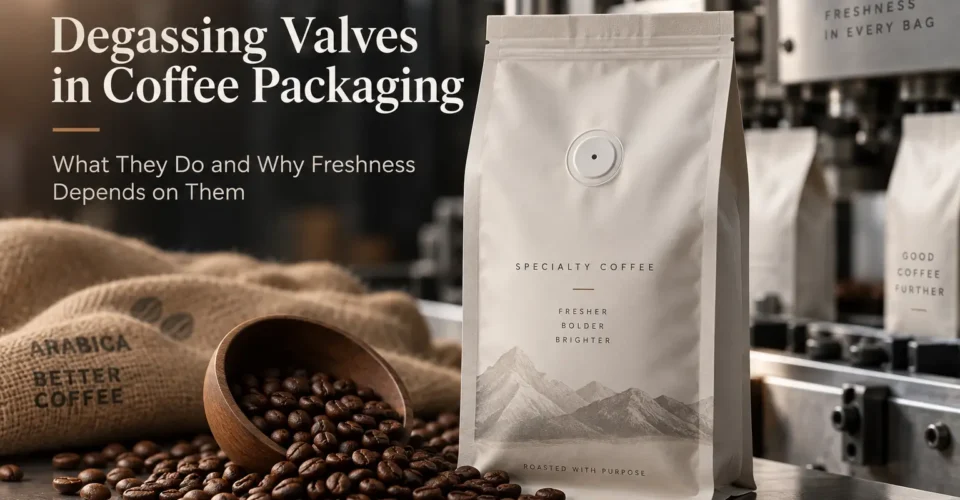
Open a bag of freshly roasted coffee too soon after roasting and you’ll notice something: it’s puffed up, sometimes almost ready to burst. That’s not a packaging defect – it’s a sign the coffee is doing exactly what freshly roasted coffee does. The question is whether your packaging is built to handle it. This is where degassing valves come in, and getting this one component wrong can undo everything else you’ve done right in your coffee packaging.
Why Coffee Releases Gas After Roasting
Roasting coffee beans triggers a chemical reaction that traps carbon dioxide (CO2) inside the bean’s cellular structure. Once roasting is complete, that CO2 doesn’t stay put – it slowly escapes over the following days and weeks, a process known as “degassing.” A freshly roasted batch can release a significant volume of CO2 in just the first 24 to 48 hours, continuing at a slower rate for weeks after.
This isn’t a minor detail. It’s central to how coffee packaging has to be engineered.
What Happens If Coffee Is Packed Without a Way to Release Gas
If roasted coffee is sealed in an airtight bag with no way for CO2 to escape, one of two things happens:
- The bag swells and eventually ruptures, compromising the seal and exposing the coffee to oxygen and moisture – the two things that destroy freshness fastest.
- Brands are forced to wait days before packing, letting coffee off-gas in open air before sealing it – which means the coffee loses aroma compounds before it even reaches the bag, and adds unwanted time and handling to the production process.
Neither option is good for quality, shelf life, or production efficiency. This is the exact problem a degassing valve is designed to solve.
What Is a Degassing Valve?
A degassing valve – also called a one-way valve or aroma valve – is a small mechanical valve fitted into a coffee bag that allows CO2 to escape from inside the pack while preventing oxygen from entering from outside. It works through a simple pressure-differential mechanism: internal pressure created by escaping CO2 pushes the valve open just enough to vent gas, then the valve closes again, sealing the pack against incoming air.
This lets roasters pack coffee immediately after roasting – while aroma and flavor compounds are at their peak – without risking bag failure from gas buildup.
How Degassing Valves Work: The Basic Mechanism
Most degassing valves used in coffee packaging follow the same core principle, even though designs vary between suppliers:
- CO2 builds up inside the sealed bag as the roasted coffee continues to off-gas.
- Internal pressure rises until it exceeds the pressure holding the valve’s internal membrane or flap closed.
- The valve opens briefly, releasing the excess CO2 to equalize pressure.
- The valve closes again, and its one-way design prevents oxygen, moisture, or contaminants from being drawn back in.
This cycle repeats automatically for as long as the coffee continues to release gas – with no manual intervention needed after the bag is sealed.
Why Oxygen Control Matters More Than People Realize
It’s tempting to think of the valve’s job as simply “letting gas out,” but its more important function is keeping oxygen out. Oxygen is the primary driver of oxidation in roasted coffee – the chemical process responsible for stale, flat, cardboard-like flavors. A valve that vents CO2 well but allows oxygen ingress on the return stroke defeats the purpose of using a valve at all.
This is why valve quality and integration matter as much as the barrier film itself. A high-barrier pouch fitted with a poorly performing valve is only as good as its weakest point.
Degassing Valves and Pouch Format Compatibility
Degassing valves aren’t limited to a single pouch style. At Vista Packaging, we integrate degassing valves across multiple formats, including:
- Side-sealed pouches – common for standard bagged coffee
- Gusseted pouches – for larger volumes with a stable base
- Zipper pouches – combining valve technology with a resealable closure for consumer convenience
- Preformed pouches – ready-to-fill formats for brands without in-house form-fill-seal equipment
Regardless of format, the valve needs to be integrated into a high-barrier film structure with low oxygen and moisture transmission rates – otherwise gas is escaping through the valve while oxygen and moisture creep in through the film itself. See our full range of tea and coffee packaging formats →
Common Mistakes Brands Make with Degassing Valves
1. Treating the valve as an afterthought. Valve placement, size, and quality should be specified alongside the film structure, not bolted on at the last stage of packaging design.
2. Ignoring valve performance data. Not all valves vent at the same pressure threshold or reseal with the same reliability. Ask your supplier for performance specifications rather than assuming all valves behave the same.
3. Pairing a good valve with a weak barrier film. A well-engineered valve can’t compensate for a film that lets oxygen or moisture pass through the rest of the pack.
4. Skipping valves for “convenience” on small-batch runs. Even smaller roasters benefit from valves if coffee is packed within days of roasting – the alternative (extended off-gassing before packing) costs freshness that can’t be recovered later.
Do Tea Packages Need Degassing Valves Too?
Generally, no. Tea doesn’t undergo the same roasting-driven CO2 release that coffee does, so most tea packaging relies on high-barrier films and airtight seals (zipper or gusseted formats) rather than valves. That said, some specialty or roasted tea products can benefit from similar barrier logic – it’s worth discussing your specific product with your packaging supplier rather than assuming a one-size-fits-all approach.
Getting Valve Integration Right
Degassing valves sit at the intersection of chemistry, mechanical engineering, and packaging design – which is exactly why they’re easy to get wrong when treated as a generic, interchangeable component. The right valve, correctly integrated into a high-barrier pouch, lets you pack coffee at peak freshness and have it arrive at the customer’s cup the same way.
At Vista Packaging, we design custom barrier pouches for tea and coffee brands – including degassing valve pouches, side-sealed pouches, zipper pouches, gusseted pouches, and preformed formats – engineered around high-barrier films that keep oxygen and moisture transmission low from production to the last cup brewed.
Frequently Asked Questions
How long after roasting should coffee be packed if using a degassing valve?
With a properly functioning valve, coffee can be packed almost immediately after roasting, since the valve handles ongoing CO2 release without requiring an open-air resting period.
Can a degassing valve fail?
Yes – valves can fail to reseal properly if they’re poor quality, damaged during filling, or mismatched to the pouch material, which allows oxygen ingress and accelerates staling.
Are degassing valves recyclable?
It depends on the valve’s construction and the film it’s integrated into. If recyclability is a priority, ask your supplier about mono-material pouch and valve combinations designed for recycling streams.
Do all coffee bags need a valve?
Not necessarily. Pre-ground coffee that’s degassed and packed after a rest period, or products with very short turnaround between roasting and sale, may not require one – but for most roasted whole-bean or ground coffee packed soon after roasting, a valve is standard practice.
Looking to specify the right valve and barrier film for your coffee packaging? Contact Vista Packaging to discuss your format, volume, and freshness requirements.